Showing posts with label food. Show all posts

Wednesday, April 15, 2015

I ate cricket! (In chip form, mind you)

We had a treat for lunch today: my cricket chips, which I pre-ordered way back in mid-winter, arrived this morning. Amusingly called Chirps, these chips come in three flavours and are the creation of a new company called Six Foods.

As you can see in the picture, the chips came with a nice canvas tote bag. I quite like the slogan on it: "Bug Appétit." I'll definitely be carrying that around in public! Also included was a sweet handwritten letter, thanking us "Bug Lovers" for supporting the company, and also providing some interesting information on their process from dream to product:

We've worked with a food pilot plant for eight months to create the recipe & it has been a huge learning experience for us. We've experimented with 50 different recipes, obscure ingredients (teff anyone?), and called over 400 manufacturers till we found the right partners.

Thank you for being patient with us through this process. As a token of our love + appreciation, there's an extra Six Foods tote for you.

Bug Appétit!
Laura, Meryl, + Rose

Wow, Laura, Meryl and Rose, you are some hard-working entrepreneurs! Good for you.

The Chirps packaging advertises that Chirps contain "3X more protein than regular potato chips," but really, they should be compared not to potato chips but to tortilla-bean chips. So I'm doing that. According to caloriecount.com, Kettle Tortilla Black Bean chips contain 3g of protein, 18g of carbohydrates and 7g of fat. Beanitos are another chip worth comparing with, as they also contain beans, although not corn. According to the Beanitos web site, Black Bean Beanitos have 4g of protein, 15g of carbohydrate and 7g of fat. Chirps chips contain 6g of protein, 12g of carbohydrates and 6g of fat. So yes, Chirps win, in terms of having the most protein. They also have less fat and a better carb to protein ratio.

At this point you may be thinking, "Never mind all that, how do they taste?"

When I ordered Chirps, I opted for the variety pack so that we could try all three flavours: natural, cheddar and BBQ. So we had to decide which one to open first. I thought the natural bag first would be a good choice, as it would allow us to better appreciate the unadulterated flavour of cricket. So we did that, and... they're quite tasty. Better than original Beanitos, I would say. They have little black dots in them, but those are the chia seeds, not the crickets. No visible bits of cricket can be detected in this product, so if you're squeamish about that, you can set your mind at ease. They look and taste somewhat like tortilla bean chips, but with a slight difference, and I'm not sure how much of that is the chia seeds and how much is the cricket. Also, they are stiffer and crunchier than the typical tortilla chip. In terms of hardness, they remind me of Mary's Crackers.

So I can recommend Chirps by Six Foods as a gentle introduction to the world of bug-eating for anyone who would like to take the plunge but is not ready to stuff a whole cricket or mealworm in their mouth, a la Millennium Farms. That's quite advanced for us weeny Westerners, and I'm happy to leave that for later.

Ingredients in Chirps, Natural Flavour

  • Navy Beans
  • Sunflower/ Safflower Oil
  • Corn Flour
  • Chia Seeds
  • Pea Flour
  • Cricket Flour (Gryllodes Sigillatus and/or Acheta Domesticus)
  • Salt

Allergy Alert

The Chirps packaging advises that "If you have crustacean shellfish allergies, you may also be sensitive to crickets."

Sunday, March 17, 2013

Recipe: Kale Chips (Garlic Flavour)

Kale chips are a tasty, nutritious alternative to potato or tortilla chips—but they cost nine dollars a bag at the health food store. It makes more sense to make your own.

Ingredients

  • 1 bunch kale, washed and dried
  • 2 tbsp. vegetable oil
  • 1/2 – 1 tsp. garlic powder, depending on taste
  • Salt (optional)

What is a "bunch?" Not a very precise measurement I realize, but the quantities are not crucial here; tweak as desired. A bunch is about what you'd get wrapped up at the supermarket. If on the other hand, you buy a whole plant at a farmer's market, it will be a good deal bigger, maybe twice as big.

Instructions

Preheat oven to 350F. You can use a toaster oven, but you might need to halve the recipe to get it to fit.

Place oil and garlic powder in a mixing bowl. Sprinkle in a little salt if you want. I don't think it's really necessary. Mix. Remove kale leaves from stems, tear into bite-sized pieces and add to bowl. Save the stems for something else. Add them to a soup or something.

Toss the leaves with the oil until well blended. I think the best way to do this is with your hands.

Spread the oiled leaves onto a baking tray and bake in oven for 10-15 minutes. You might want to flip them halfway through. Keep an eye on them so they don't overcook. They're done when they're crispy all the way through and brown at the edges but not right to the middle. Delicious!

I developed this recipe on my own. Then, when I decided to write it up and post it, I did a search online and discovered that there are already a bazillion kale recipes available. So, I'm not as original as I thought, and maybe my drop in the bucket is not really necessary. Still, here it is, for what it's worth, and I hope it's worth something.

Wednesday, August 22, 2012

McCabe's: New Brunswick's finest ice cream is found by the highway in the middle of nowhere

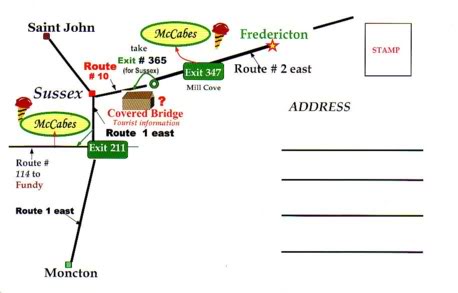
Postcard

It probably seems out of proportion to get in the car and drive 40 minutes for ice cream. But this is no ordinary ice cream.

My husband found out about the place on a drive to Moncton a year or two ago, when he saw their road sign and popped in for some vanilla. He remembered it favorably enough to mention it to me one Friday evening in July, when the subject of ice cream came up. He thought it was about 20 minutes away.

My reaction was, hey, if it's that close, let's jump in the car and go! James demurred. It was evening. They might only be open in the daytime.

We tried to find out the telephone number, so we could call and find out their business hours. There was no entry under the Yellow Pages category Ice Cream & Frozen Desserts—Retail. We tried the Internet. There were some forum references to McCabe's, but no web page and no business hours. Likewise, yellowpages.ca had no entry for McCabe's. This business was unlisted! Whether this was some strange oversight or the place simply had no phone, there was no telling, and nothing to do but go there in person. But not that evening, especially since Google Maps' directions indicated that James' estimate of the distance was off by 100%: not 20 minutes, but 40.

It had to wait until Sunday. In the interest of pretending that this was not just an unusually long ice cream run but a whole day trip, we did some research on the area. Cambridge-Narrows is the closest town. Its tourism web page consists largely of a well-nigh unreadable scan of their brochure, 14 Things to Do in Cambridge-Narrows. At least it had a tourism web page. And a lake, so possibly there would be swimming. I threw a bathing suit, towel and cooler (in case they sold pints and we wanted to take some home) into the trunk, and off we went.

MCcabe's might not have a web presence, but their highway presence is more than adequate. The big sign at the side of the road is hard to miss, with its flashing yellow lights in the shape of an arrow. James pointed this out to encourage me, as I'd spent a substantial part of the drive fretting about the fact that it was Sunday, and things tend to close on Sunday in New Brunswick. Try going to Saint John, one of NB's biggest cities, on a Sunday. Almost nothing will be open. "How do I manage to forget this every time?" I'd lamented. "We'll have driven 40 minutes for nothing," etc., etc.

"Look, the arrow's flashing," said James. "That means they're open."

A further aid in guiding drivers is a red balloon, floating high in the sky above the spot.

After the sight of the giant sign and balloon, it felt incongruous to round the corner and see the tiny beige house. Outside, it didn't look like much. Inside, they offered a tiny selection of seven flavours. The menu was divided into regular flavours—vanilla, strawberry and chocolate—and the more expensive gourmet—coffee, mocha, raspberry and maple cream.

I mulled over the gourmet options but since none of them appeared to contain chunks of things, I chose that old standby, chocolate. James chose vanilla, the same flavour he'd had the last time.

I tasted my ice cream. OK, I thought, worth the trip. Maybe that's as much a comment on Fredericton ice cream parlours (or should I say ice cream parlour?) as it is on McCabe's. But my scoop was creamy with a rich chocolate flavour.

But I hadn't tasted nothin' yet. James offered me his vanilla, and then I knew I was in the presence of greatness. There was an explosion of vanilla bean on my tongue.

Honestly, I've never had a vanilla ice cream to equal McCabe's. Not Haagen Daaz. Not even Ben and Jerry's. And I still hadn't tasted nothin' yet. But more on that later.

The place is run by a smiling elderly lady with an accent that I couldn't place. I never found out her name, so I will take a chance and call her Mrs. McCabe. I asked Mrs. McCabe about pints. They don't sell them. If I wanted to take some home, my only option was two scoops in a styrofoam container.

I decided to get gourmet flavours, since we hadn't tried them yet: one scoop of mocha and one of maple. As Mrs. McCabe excavated our scoops, I asked about hours. McCabe's is open from 9:30 in the morning til 7 at night, seven days a week, from Victoria day to one week after Thanksgiving. Mrs. McCabe remarked that some of their customers buy a whole vat of ice cream, of the sort that the scoops come out of in the shop, so that they can have ice cream all winter. I have it on good authority from my ice-cream-fanatic father that those are three-gallon vats. One vat costs between 70 and 80 dollars, depending on the flavour, and requires a chest freezer. It's a special ice cream that inspires such devotion.

We also found out that they do not, in fact, have a phone number for the business. When I asked, Mrs. McCabe said with obvious reluctance that she could only give me her personal number. I could not in good conscience make such a request. They do have an email address though: homemade at auracom dot com.

Mrs. McCabe also wanted us to know that they had another location, on the road to Fundy Park. We'd actually come across that other address during our web searches, much to our confusion. This other location, she told us, was run by her husband. Here was a couple as devoted to their business as the vat-buyers are devoted to the ice cream. For their entire ice cream season, spring to fall, they get no days off, and they work miles apart from each other. I wonder what they do in the winter. It would be nice to imagine that they spend it taking a well-deserved vacation, but I fear it may not be the case.

Noting my interest in the business, Mrs. McCabe gave us a postcard gratis with our ice cream, though a sign on the counter said they were a dollar each. She also assured us that the ice cream is made from all natural ingredients. That was obvious. You can't get that intensity of flavour from anything but.

We put the ice cream in the cooler with a couple of cold packs, and set out to explore Cambridge-Narrows. We had lunch at Holiday Restaurant, a diner-type place just past the bridge. They do a pretty good hamburger and a surprisingly elegant salad, with a cucumber rose. Unfortunately, the dressing selection is the usual French-Ranch-Italian.

I asked the waitress if Cambridge-Narrows had a downtown. "Honey," she said, "this is it."

The centre of Cambridge-Narrows is a cross-roads. Signposts give the direction of places of note: the library, the post office, a winery. We visited the library, the wharf and the winery, Motts Landing, where they offer a delicious Chantilly.

It appears that the locals are not aware of the greatness of the ice cream in their midst. I mentioned to one woman that we'd come into the area for McCabe's ice cream. She got an odd look on her face. "I've wondered about that place," she said. "You drive by and that Cadillac is sitting there, and there are no other cars, and it makes me wonder if they really sell drugs or something." I assured her that there had been plenty of other people buying ice cream when we were in there; indeed, there was a lineup most of the time. "Well," she said, "that's good to know."

As we headed home, I noticed the time and began to fret. I'd read somewhere that a good cooler or thermos keeps its contents cold for three hours. More like four hours had elapsed. Were we going to end up with ice cream soup?

There was a fair quantity of soup, some of which had leaked into the cooler. As for what was still in the container, it maintained a small island of slushy solidity in the centre of a pool of melt—a testament, I thought, to the efficacy of my cooler, given how much time had elapsed. The slush even retained some degree of separation between the mocha and the maple, so we were able to taste them separately. Both were delicious. We put the ice cream in the freezer to harden it up again. Ultimately, though, we ate it all before that could happen. It was even better than the vanilla.

The McCabe's location that we visited is at exit 347 off the Trans-Canada highway, heading east. The other location is at exit 211 off Highway 114, heading to Fundy, as illustrated on the back of the postcard.

Friday, June 15, 2012

Recipe: Vivian's Dark Chocolate Orange Peel Bark

This recipe came about the day my hubby and I returned from grocery shopping with a bag of discounted oranges and a chocolate bar. I thought, why not put these two things together? So I did a search online for chocolate orange bark recipes, and discovered that the orange peel was invariably candied through the use of white sugar. Being me, I couldn't help but marvel at the oddness of adding outside sugar to a substance that surrounds a lot of naturally-occurring sugars and vitamins. So I decided to see what would happen if I used the juice from the orange instead of sugar and water. What happened? Deliciousness, that's what happened.

Ingredients:
  • 100 grams dark chocolate, preferably 60-80%
  • 1 orange

Wash the orange, cut in half and juice. We have one of those manual orange juicers where you impale the orange half on a conical thing. If you don't have a juicer, you might try squeezing by hand and/or with the back of a spoon, but try not to mess up the peel too much, because you're going to need it.

Put the juice aside and cut the spent orange halves into segments. Remove the squished pulp. It's not used in the recipe, but it's still good eating. Now lay each segment zest-side down and slice away the pith with a paring knife or other small, non-serrated knife. Watch the fingers. (If you don't know, the zest is the orange stuff on the outer part of the peel and the pith is the yellowy, bitter stuff on the inner part of the peel.)

Throw away the pith and slice the zest into little strips, about an eight of an inch thick. Put the zest strips into a saucepan with the juice from the orange and bring to a boil. Lower the heat and simmer until the liquid is almost boiled away, stirring often. The zest will be coated with a sort of sticky juice reduction. Scrape it out of the saucepan and put it on a plate. I left it for a couple of hours in the fridge to dry out, but really I don't know how much difference this made; it never got completely dry. So skip this step if you don't have time, in which case you don't even have to turn off the burner. But you'll probably want to use a clean saucepan for the next step. Chocolate changes its texture if you get liquid into it when it's melted.

In the clean saucepan (or in the orange-juicy saucepan if you couldn't care less about your chocolate's texture—I mean, it's chocolate, right?) melt the dark chocolate over low heat. The traditional way to do this is with a double-boiler, to prevent burning. I don't have a double-boiler, so I just use the lowest setting on my electric stove. If you have a gas stove, I suppose you might not be able to get away with this. And if it's a warm day, leaving the chocolate out in the sun for a while might also be an option.

Use a rubber or silicone spatula to scrape the melted chocolate out onto a cookie sheet, aluminum pie plate, or something else flexible. (If it hardens on something rigid, like a plate, you may have trouble detaching it.) Finally, sprinkle the juicy orange peel over top. Oh sure, you could have just stirred the peel into the chocolate, the way you would with almonds if making an almond bark, but the orange peel is such a pretty colour, especially against the dark background of the chocolate, that that would be a shame. This way, you can listen to your friends ooh and ah over the beauty of your candy. Refrigerate until firm, about 2 hours. It's a nice thing to bring to dinner parties. Or you can stay home and eat it all yourself, which is the option my husband and I chose.

Sorry I don't have a picture. It didn't last that long. I'll see about taking one next time I make this.

Tuesday, August 16, 2011

A Radical Restaurant Proposal

How about bringing me what I ordered? And nothing else?

Today I met a friend for lunch at a restaurant. I ordered a chicken Caesar salad... very carefully. No croutons. Dressing on the side. I thought that should have done it. I mean, I know what goes into a Caesar salad. But the salad arrived with two big slices of garlic bread sitting on top.

Expressing my surprise, I picked off the offending slabs and explained to the waitress that I neither wanted the bread nor could eat it, since I have celiac disease. An agonizingly drawn-out conversation followed.

"Should I have them make you a new salad?"

"I don't think that's necessary. I hate to waste food."

"Are you sure you'll be OK?"

"I don't think I'm so sensitive that one breadcrumb is going to affect me."

"But it might be better to be safe..."

"It sounds like you'll feel more comfortable if you make me a new salad."

"No, this is for you..."

And on, and on. Finally I persuaded her that the salad was all right for me to eat, and handed her the bread. I like to dump pieces of bread right in the hands of serving people. They seem reluctant to touch it. Maybe they don't want to get butter on their hands. But what do they expect me to do with it? Leave it in a heap on the table? Perhaps make it into an impromptu centrepiece?

Before the waitress left, she told me that in the future, I should always tell my server about any allergies I have before ordering.

"She's right," I said to my lunch companion. "I should." I wondered why it is I'm reluctant to do so. Perhaps it's a desire to avoid that scarlet letter feeling, that public declaration of oneself as a sickly oddball. But something else was bothering me. I thought I'd ordered pretty carefully, and somehow it wasn't enough. Why did I feel as though the waitress, indeed the entire restaurant business, is somehow trying to fob its responsibilities off on me?

Later that day, I figured it out. I'm tired of restaurants serving me food that I didn't ask for and don't want. Is this such a radical notion: serve me what I ordered, and not what I didn't order?

I don't think I'm merely being whiny. It's true that I don't enjoy the necessity of giving a spiel on my digestive health to the wait staff every time I eat out. But in fact, this is not just an allergy problem. Once, I ordered chili at Boston Pizza and it arrived with cheese all over it. I didn't want cheese. Nothing in the menu said that the chili came with cheese. I could not have avoided this situation by discussing my allergies with the waitress, since I have no dairy allergy.

I didn't send the chili back. I carefully scooped off the cheese and deposited it on the side of my plate.* As I said earlier, I don't like to waste food. Also, I think today's prevailing restaurant climate may have affected me. I felt as if the situation was my responsibility because I hadn't read the cook's mind all the way from the dining hall. I had failed to anticipate that he might put unrequested cheese on my chili.

Ketchup can also be a problem. It's an oddly popular condiment, so restaurants tend to assume you want it. Many wait people will slap a ketchup squeeze bottle on your table as soon as you put in an order, whereas if you prefer vinegar on your fries, you have to ask. I don't mind the ketchup squeeze bottle, but I hate it when a little ketchup-filled plastic tub appears on the side of my plate with my meal because I know that every ounce of it is going to end up untouched in the garbage, along with the once-unused plastic tub. All waste, which could have been avoided if only they'd asked.

And what happened to asking? Remember when wait staff used to ask you questions? "Fries or baked potato? White or brown toast?" Some of the higher-end restaurants, like Swiss Chalet, still do this.† But many don't. I think this may have to do with the newish trend of dropping by your table after you've received the food and asking something like, "How's everything tasting?" or "Is there anything else I can get you?" Perhaps wait staff decided that there are only so many questions they can deal with having to ask, and if they had to ask these post-order questions, then the pre-order questions had to go.

Well, I don't think this is a worthwhile trade-off. The pre-order questions are more important. Rather than abandon pre-order questions in favour of the repetitious and potentially disruptive "Can I get you anything else?," restaurants should provide patrons with some sort of signalling device they can use to let the wait staff know when they need something. I have long thought it would be great if restaurant tables each came equipped with a little flagpole and flag that you could raise when you needed service. This would be easier for the customers and easier for the staff. Further, the flags could add to the overall design motif. They could be brightly coloured, or styled to match the room decor. Restaurateurs, please feel free to use this idea without giving me credit. The joy I may one day feel upon walking into a restaurant and seeing a mini-flagpole on each table will be reward enough for me.

If you don't want to ask questions and you don't want to equip the tables with flagpoles, why not print on the menu everything that comes with the dish by default? Then at least people like me will be in a position to specify what we want and don't want on our plates. We won't have to wrack our brains to work out every surprise ingredient the cook might decide, on some crazy, onion-fume-influenced whim, to plunk on top of the meal.

I know I can't change the world. I can't make restaurants stop serving me things I didn't ask for. So I resolve from this day forward to tell wait staff that I have celiac disease. Frankly, I doubt it will solve the problem. I fully expect that at some future date, I will order by saying, "I have celiac disease. I can't have any wheat. So I'll have the chicken Caesar salad, no croutons, dressing on the side." And the salad will STILL show up with garlic bread on top. And the waitress will be all like, "Oops, garlic bread has wheat in it." Because waitresses aren't paid to think. If they were, they might wonder why a person who didn't want croutons would want garlic bread, which is, after all, a larger chunk of the same exact thing.

So I'm quite sure that the scenario I've described will eventually come to pass. But when it does, I'll be able to send the food back with a clear conscience. Likewise, my other resolution is to return any dishes that come with unexpected cheese on top. Yes, there will be food waste, and no, I won't be the one responsible.


* When my husband proofread this, he suggested I could dump the cheese into the waitress's hand, the way I did with the bread. I thought this amusing enough to share, although I want to make it clear that I do not advocate waitress abuse of any kind. [back]

† I live in Fredericton, New Brunswick. Here, Swiss Chalet is one of the higher-end restaurants. [back]

Friday, July 22, 2011

How to Make Gluten-Free Bread: a Quick Primer and Three Recipes

Gluten, that super-long protein string that gives wheat bread its delectable fluffiness, can also make some people sick. In celiac disease, the consumption of gluten creates an immune reaction in the intestines and flattens the villi, the little hairlike things that are responsible for absorbing nutrients. No villi, no nutrient absorption. You can see how that would not be a good thing, but it gets worse. People who have celiac disease but continue to eat gluten are at increased risk for colon cancer and type I diabetes. So if you have this condition, it's really important to lay off the gluten.

An interesting fact about gluten: no human being can digest it. That's right: even if you're not celiac or gluten-sensitive, you're not breaking the stuff down. Not being birds, we're not designed to eat grains. It's just that in most people, the little strings sit around quietly in the intestine not causing trouble, while in a minority of people, the intestine gets fed up with the alien presence and launches an immune system attack.

So what to do if you belong to this minority? Whether we're designed to eat grains or not, most of us don't want to give up eating pizza and sandwiches.

The trick is to find another substance that will bind your dough together the way that gluten does. Two types of ingredient that will have this effect are gums (xanthan, guar, etc.) and eggs. In most cases, you'll need to add either a gum or some eggs to your dough, or the resulting bread will crumble to bits, and that's a pain when you're trying to butter it. (For the one exception I know of to this rule, see socca bread. That's a flatbread though.)

Most gluten-free recipes also include some sort of starch, typically a mixture of some of the following: potato, corn, tapioca and arrowroot starch. Starch lightens up the bread so it can rise higher. It is not a requirement though, as we'll see later.

As for the flour, a blend of flours are typically used. One popular flour in gluten-free recipes is garbanzo-fava flour, a mixture of chick pea flour and fava flour. This flour, often referred to as garfava for short, is said to rise well. Rice flour is commonly used as the base flour. Buckwheat is sometimes added for extra fibre. Sorghum flour, from the seeds of a grasslike grain, is added for flavour, as it has a natural sweetness.

This is about all I know about gluten-free flour blending, which appears to me as an arcane science akin to alchemy. Still, I say, don't be afraid to experiment. The worst that can happen is that you'll have to throw out a loaf of bread. And most of the time it isn't that bad. At the least you can usually turn it into breadcrumbs and bread fish with it, or make it into turkey stuffing.

But maybe you don't want to bake. Baking is a lot of work. You might want to go to the supermarket and buy a gluten-free bread in a bag, premade. Fair enough, but there a couple of things you should know:

  • Most store-bought gluten-free bread is disgusting. It's like chewing on a mattress, only with less flavour.
  • Most store-bought gluten-free bread is very low in fibre, because it is made primarily out of white rice flour*. This goes a long way towards explaining its lack of flavour as well.

That said, I do know of a great gluten-free bread mix that you can buy in a supermarket. It's not a premade bread, so you still have to do some work, but it's worth it. It's better than any other gluten-free bread I've tried. It's Bob's Red Mill Homemade Wonderful Bread. The name sounds boastful, I know, but they're telling the truth.

If you're just starting out with gluten-free baking, you may be reluctant to go out and purchase a weird and freaky ingredient like xanthan gum. I know I was. So try the following two recipes, which can be made without it. They also don't contain any starch. The third and final recipe is a more traditional, gummy, starchy, gluten-free bread recipe; basically, it's my attempt to duplicate Bob's Red Mill Homemade Wonderful Bread, and I think I didn't do too bad a job of it, if I do say so myself.

Recipe #1: Rolls

This recipe is really passover rolls with gluten-free flour taking the place of the matzoh meal. You see, during Passover, in commemoration of the escape from Egypt when the Jews had to make a quick snack before fleeing, leavened bread is forbidden. That means no yeast or baking soda. However, Jews have a long history of getting around the letter of the law while doing what they want: witness that string that Hassidim put around their neighbourhoods during Shabbos. So naturally they found a way to make rolls light and fluffy without yeast or baking soda. It just takes a lot of eggs.

This recipe is adapted from the recipe for passover rolls in Second Helpings, Please! Revised edition. Mt. Sinai chapter #1091, B'nai B'rith Women, Montreal, Canada.

  • 2 cups gluten-free flour (whatever kind you want: I used 1 cup brown rice flour and 1 cupbuckwheat flour. If you like it sweet, throw in some coconut flour)
  • 1 tsp. salt
  • 1 cup water
  • 1/2 cup oil
  • 4 eggs

Combine dry ingredients. Bring oil and water to a boil and add to dry ingredients. Mix. Beat in eggs one at a time. Let stand for 15 minutes. Preheat oven to 400 degrees F. Oil a cookie sheet.

Oil or wet your hands so that the dough won't stick, and shape rolls. Place on cookie sheet. Bake for 1 hour or until brown.

The resulting rolls are nice and crispy, and surprisingly puffed up inside. Now, you may be concerned about using such a lot of eggs. I find you can reduce it to three eggs and still get good results. Just replace the missing egg with 1/4 cup of water. You can also replace as many eggs as you like with egg white, for a lower-cholesterol roll.

Recipe #2: Socca

This recipe is from Mediterranean Light: Delicious Recipes from the World's Healthiest Cuisine by Martha Rose Shulman. Shulman does great cookbooks.

  • 2/3 cup chick pea flour
  • 1/4 to 1/2 tsp. salt
  • 1 cup cold water
  • Pepper
  • Olive oil

Beat together the flour, salt and water with a whisk or blender until there are no lumps. Add freshly ground pepper to taste.

Now, some timing issues. The oven has to preheat for 30 minutes, but the pan has to heat up for 15 minutes. So as soon as you've got your batter beaten up, turn the oven to 475 degrees F, then set a timer for 15 minutes. Oil a pan with the olive oil; a 12-inch pizza pan will do nicely. When the timer goes off, stick the pan in the oven and set the timer for another 15 minutes.

When the timer goes off again, yank the hot pan out of the oven (don't forget your oven mitt!) and pour in the batter. Put it in the upper third of the oven. Shulman says to bake for five minutes, then turn the oven to broil and broil for 3 to 4 minutes. I don't think I bother to do this. It's been a while since I made this bread, but I think I probably just bake it for 8 or 9 minutes.

Full disclosure: the reason I don't make this bread often is because it's wildly addictive and I ate myself sick on it the last time.

Recipe #3: Sandwich Bread

As I said above, this is my attempt to make something similar to Bob's Red Mill Homemade Wonderful Bread.

  • 1 1/4 cup chickpea flour
  • 1/4 cup fava flour (or: replace the above with 1 1/2 garfava flour)
  • 1/2 cup sorghum flour
  • 1 cup starch (I don't think it matters terribly which one you use. To get closest to Bob's recipe, try 1/2 cup potato starch, 1/2 cup minus 1 tbsp. Corn starch and 1 tbsp. Tapioca starch)
  • 1 tbsp. Xanthan gum
  • 1 1/2 tsp. Salt
  • 2 1/4 tsp. Yeast
  • 1 1/2 tbsp. Maple syrup
  • 1 beaten egg + egg whites to 3/4 cup
  • 1 tsp. Cider vinegar
  • 3 tbsp. Olive oil
  • 1 2/3 cup water

Warm up the water. I like to put it in the microwave for about half a minute. It should be about bath temperature, not so hot that you can't comfortably wiggle a finger in it. Add the yeast, stir and let sit 5 to 10 minutes while you blend the rest of the dry ingredients together. Mix the eggs, egg whites, maple syrup, cider vinegar and oil in a separate bowl. When the yeast is ready, add to the wet ingredients and then mix the dry ingredients to the wet ingredients until well blended. Bob's Red Mill actually says to use an electric mixer, but I find a fork adequate to the task.

Preheat the oven to 375 degrees F. Oil a loaf pan and pour in the batter. Smooth out the top with a rubber spatula. Cover and let rise in a warm place for 20 minutes. Place in oven and bake for 45 minutes. Bread is done when it makes a hollow sound when you tap it. Let it cool in the pan for 20 minutes before removing and cooling all the way on a rack.

Variations:

  • Egg-free version: You can reduce or remove the eggs by substituting water. One egg is equal to about 1/4 cup of water. If you remove all eggs, you should also up the xanthan gum by a teaspoon.
  • Starch-free version: Starch is not essential to gluten-free baking. It is just used because people are accustomed to light and airy baked goods. You can substitute the starch with the same amount of brown rice flour.
  • Egg-free, starch-free version: You can do both the substitutions described above at the same time. However, the result is not as tasty, in my opinion. It might be worth replacing some of the egg with apple sauce, although I haven't tried this myself.

Rest assured that all suggested substitutions (aside from the apple sauce one) have been tested in Vivian's kitchen have have been found to give acceptable to delicious results.

Further Reading

The best gluten-free cookbook I have found so far is unquestionably Babycakes by Erin McKenna. It's more dessert-centred, featuring cup cakes, cakes, muffins and pies, but there is also a chapter on tea breads (breads made with baking powder rather than yeast). All recipes are scrumptious. On top of all that, Erin goes to some lengths to make her desserts as healthful as possible; most are sweetened without sugar. Note that not all recipes in the book are gluten-free; some call for spelt flour.


* Can I just say something here? Why does white rice flour exist? Why does white rice exist? Why doesn't everybody just eat brown rice? Is it part of that self-destructive human condition that also leads to the existence of movies like Jackass 3D? What I find particularly weird about white rice flour is that even brown rice, really, doesn't have much fibre. It's a lot lower in fibre than rye or even wheat. So if you find fibre that unappealing, brown rice should be fine. [back]

Saturday, December 25, 2010

My Christmas Dinner 2010: Recipes and Suggestions

You may be wondering what a Jewish woman is doing preparing Christmas dinner, much less writing about it. It's true that I'm nominally Jewish, but the ubiquitousness of Christmas--the carols, the TV specials, the shopping madness, the time off work--is a reality of the culture in which I live. Anyway, Paganism has always spoken to me more than Judaism or any other religion that emerged from the Middle East, and really, Christmas is Yule, a pagan celebration of the winter solstice. None of the customs, from tree decorating to lights, have a thing to do with Jesus, who, if he ever existed (which some have called into question), was born in a desert in July, and was, to boot, a nice Jewish boy. So there. Now on to the food.

Sweet Potato and Apple Stuffing

This is a modified version of a recipe I got from The Good Cook: Poultry, by Time-Life books, who in turn got it from Louisiana. I'm always interested in stuffings that don't contain bread. In addition to being a pleasant change from the ordinary bread-based stuffing, they are gluten free and good for celiacs and anyone else who doesn't do well with wheat. It's delicious too.

The original recipe calls for sugar. A lot of recipes with sweet things in them call for sugar. Sweet potatoes with sugar. Beets with sugar. And so on. I have always found this to be insane. It's like putting blue eyeshadow on a blue-eyed woman "to bring out her eyes," except that instead of simply being in bad taste, it's bad for your health as well. No sugar in this version, and it's still plenty sweet.

  • 4 cups diced apples
  • 1 cup chopped celery (I didn't have any, so I used white turnip)
  • 1 cup water
  • 6 sweet potatoes (about 3 lb.)
  • 2 tbsp lemon juice (I used cider vinegar)
  • 1 tsp ground cinnamon
  • 4 tbsp butter
  • 1 cup chopped pecans or walnuts
  • grated peel of 1 lemon (I left this out)

The recipe said to peel the apples and sweet potatoes, but I didn't bother. Both have perfectly edible skins. Yes, the sweet potato does too. Try it some time; it saves effort and reduces food waste.

Steam or boil the sweet potatoes for 25 minutes. While you mash the sweet potatoes with the butter and cinnamon, simmer the apples and celery in the water until tender. (If you use turnip, as I did, you'll need to put it in first because it takes longer to cook than the apple.) Mix the apples, celery and chopped nuts into the sweet potato mush and stuff it into your turkey.

Turkey-Cooking Suggestion

Cookbooks and every other turkey-cooking expert I've ever heard of advise you to place the turkey on its back to cook it. It is, I believe, a presentation thing, but results in the quickest-cooking part of the bird--the breast--being exposed to the most heat. You are then expected to get around this by basting, or by covering the breast with bacon. If you're lucky, it works out. More likely, you end up eating overcooked breast meat, or slicing off the breast meat and eating it first while you put the still-uncooked remains back in the oven, because you've been waiting for hours and you're starving and you can't take it any longer.

Well, try this. Place the turkey on its breast instead. Now the dark meat, which takes longer to cook, is getting the most heat, while the white meat is protected from being overcooked. Doesn't that make more sense? I think so. It's what I did this year and my turkey came out perfect. The stuffing was fabulous too--better than cranberry sauce.

Mince Pie

A modified version of a recipe from The Vegetarian Feast by Martha Rose Shulman. Here's another recipe that cries out to have its sugar removed. It's made mostly from dried fruit, which is very sweet, plus it contains juice. Why would you add sugar, or even honey or other sweetener? That would be dumb. Leave it out, and you can actually taste the fruit. And buying mince pie filling in a jar, when you can easily make a more delicious version at home, is also questionable.

  • 1 pie crust (see below)
  • 1/2 cup currants
  • 1/2 cup raisins
  • 2 apples (I used russets; they're very nice)
  • 1/3 cup chopped, pitted prunes
  • 1/3 cup chopped, dried, pitted apricots (get the sulfite-free ones from the health food store; they're better for you)
  • 1/4 cup chopped, pitted dates
  • 1/2 cup broken pecans or walnuts
  • Juice and grated peel of 1 orange (I used a Mandarin orange)
  • 1/4 cup water
  • 1/2 tsp ground cinnamon
  • 1/2 tsp ground clove
  • 1/4 tsp ground nutmeg
  • 3 tbsp rum (I used Screech rum from Newfoundland; good stuff)

Since preparing Christmas dinner is a huge chore, a job for a masochist, it's a good idea to make the filling part the day before. Grate the orange peel, then cut the orange in half and juice it. (At which point, if you used a Mandarin orange as did I, you will discover that the peel disintegrates under the stress. So proceed with care.) Throw the dried fruits, nuts, juice, peel and water into a pot, bring to a simmer, cover, and cook over low heat for 20 minutes or until it's all nice and mushy. Add the spices and booze, mix and cook for another 5 minutes. There. You're done. Told you it was easy.

Pie crust

One of the things that has mystified me all my cooking life is why cookbooks call for such a small amount of water in pie crust. "Oh yes," they coo, the liars, "just chill those 3 dainty tablespoons of water with those ice cubes, and your crust will be fine." Then you try to roll it and it cracks into particles like a freshly-unwrapped ancient mummy. (Sorry if that metaphor wasn't appetizing.) Well, I've had it. I'm doubling the water quantity, and if any pie crust experts out there want to float over to this blog and mock me, feel free. I'll just ignore you.

  • 2 cups some kind of flour (this year, I used 1 cup brown rice flour and 1 cup buckwheat)
  • 1/2 tsp salt
  • 1/2 oil or fat (I used chicken fat. There, that's Jewish)
  • 1/2 cup or more water, and I don't believe it makes any difference whether it's iced or not

Preheat oven to 350 degrees F. Combine dry ingredients. Work fat into flour mixture with hands, a butter knife or one of those pastry cutter things until the little bits are smaller than peas. Mix in the water and add as much as you need to make a dough that holds together. Roll the dough out on a floured surface, or if that doesn't work out for you, which it often doesn't for me, pick it up in little pieces and press it into the pie pan, as you would for a crumble crust. There's no shame in that. Pie crust is like love and war: all's fair so long as it gets the job done. Poke a bunch of holes in the bottom with a fork and prebake for 5 minutes.

Remove from oven and cool, then spoon in the mince. Top with a lattice crust if you like, or with an unbroken top crust, or even sprinkle the dough on like a Dutch apple pie topping if that works better for you. Did I mention pie crust is like love and war? Now stick it back in the oven and bake for 40 minutes. Cool and eat, if you have any room after all that turkey. If not, it makes a delightful breakfast.

--Brought to you by The Rebel Cook (my new name for my cooking alter ego)

Monday, April 26, 2010

Silliest New Product Award 2009

Once again, the time has come to bestow the Silliest New Product Award. A long time has passed since I last gave out this award, for Bagel-fuls. But please understand that this award is not just for any minor foolish product. If it was, I could give it out weekly. But no--a Silliest New Product must scale the Everest of foolishness. And at last, we have a contender.

Once again, the product in question is a food product. I will have to start keeping an eye out for foolish devices or articles of clothing. I don't want to limit myself to food, although admittedly it's something I get passionate about. This food product is even sillier than Bagel-fuls was. It add a whole new dimension to silly food, in my opinion. There's no denying that our society is loaded with silly food, even dangerous silly food. Yes, we keep trying to find ways to stuff more caffeine into our beverages. Yes, our desserts are so sweet that sugar is often the first ingredient. And let's not forget poutine.

The thing is, though, we know that that sort of stuff is junk food. People may joke that poutine is a meal, but they don't eat it as such too often, unless they actively want to die young. As much junk food as we eat--and we eat a lot of it--at least we are aware, however dimly, that it's not a real meal, and not something we should be eating very often.

But what if some daring and black-hearted individual should redefine the meal? What if you could eat something that was incredibly bad for your health, but still feel as if you'd had a perfectly adequate meal and were not doing anything wrong? For such is the cunning of my award recipient that he, whoever he may be, has entirely redefined the concept of "meal" in just such a revolutionary way.

Oh, we've had meal redefinition before. Don't get me wrong. I am aware of the bold stroke that created the TV dinner: meals apportioned out in a partitioned foil tray. (That was before the advent of microwaves, of course; now it's a partitioned plastic tray.)

Still, the TV dinner, and its offspring, the nukeable dinner, continue to give lip service to the idea of food groups. Some form of vegetable matter still constitutes part of the meal. Said vegetables may be limp and tasteless and people may not eat them, but at least they're there.

Then there's the junk food meal, with its three food groups: hunk of meat with filler, bun, and fries stuffed into a little cardboard packet. Admittedly, the vegetables are absent, but at least some degree of food groupage remains. Also, look at the name. We recognize that this is junk. We don't take it seriously. That's important. In this age of rising obesity and diabetes rates, it may be little enough to hold onto, but it's something.

The real coup has come with the throwing out of food groups altogether. Now, it seems, we are ready to accept the concept of a meal consisting of just one food group, and in a form almost totally devoid of fiber and nutrients. At least, somebody thinks we are, and frighteningly enough, he may be right. It is a stroke of Lex Luthor-like genius. Ladies and gentlemen, I give you... drumroll, please... Domino's Pasta in a Bread Bowl.

That's right. What's pasta made of? White flour. What's the bread bowl made of? White flour. So you have a situation where someone can consume a great big lump of refined flour product with a little bit of creamy sauce on top (also containing white flour) and consider that he or she has eaten a meal.

This is bad, folks. This is very, very bad, although perhaps it is the logical end of decades of addiction-fueled, simple-carbohydrate binging. But I don't think we can just blame the consumer in this instance. I refuse to believe that Domino's has been hounded by people crying, "Stop serving us our pasta in real bowls--we want it in pizza dough! It's the only way we can get enough bready stuff!" No. I think what's going on here is that Domino's is actively trying to kill us.

This brings up the question: Why is Domino's trying to kill us? My best guess is, for the fun of it. I think they're serving up those bread bowls and then hunkering down like Kilroy and peeking through the little window where the waitresses leave the orders, watching as the customer eats his "meal" and giggling maniacally to themselves. Perhaps saying things like, "Oh my God, he's eating it! What a moron!" Much like Colbert Report viewers did when that suicidal guy ate a fifteen-pound burger.

Now, you may argue that this is a shortsighted way to do business. Sure, you have a little fun watching the mayhem. Sure, your customers' addiction to simple carbohydrates gets even worse, and you do a brisk business for a while. But then they die, and where is your business then? OK, there's a new generation, but if they do the same thing, they'll die untimely deaths as well, and eventually the shrinking population is going to impact your bottom line, right? It's not a good long term plan, is it?

To which I'd respond, hey, it's worked for the producers of cheap alcohol. So far, anyway. And let's face it, most businesses are based on short-term gain. Hell, the whole economy's based on short-term gain. That's why nobody wants to do anything about global warming.

But I sense myself drifting off-topic, so let me just return to the point and say, Dominos, you suck. Once, you seduced me with your Extravaganza pizza. But with Pasta in a Bread Bowl, I have lost all respect for you.

Friday, February 5, 2010

Recipe: Maritime Bean Dip (and bonus Pizza)

Jacob's cattle, soldier and yellow eye are three varieties of bean that are commonly grown in the Maritimes of Canada. If you buy one of these types of beans at the supermarket, it will in all likelihood come with a recipe on the bag, a recipe that never varies. It is Molasses Baked Beans. It is always, always Molasses Baked Beans, as if no Maritimer has ever done anything else with a bean.

That seems a shame to me, not to mention boring, so I have taken it upon myself to provide the bean-buying world with other things to do with a bag of yellow eye or soldier or Jacob's cattle beans, starting with this tasty bean dip that may, if you are so inclined, be made entirely with Maritime-grown ingredients.

The Dip

Ingredients:

  • 1 cup yellow eye, soldier or Jacob's cattle beans
  • 1 or 2 cloves garlic
  • 2 tsp. apple cider vinegar
  • 1 tsp. salt
  • Ground black pepper, to taste

Soak the beans 4 to 6 hours or overnight in 3 cups of water. If you're not good at advance planning, you can use the quick-soak method: bring water and beans to a boil, cover, turn off heat and let sit for an hour.

Whichever soaking method you use, once the soaking is complete, bring the beans to a boil, reduce heat, cover and let simmer until soft--from 30 minutes to an hour.

Drain beans, place in a bowl and mash. (If you're feeling lazy or have arthritis, use a blender or food processor.) Mince or press garlic and add to mashed beans. (For extra points, use garlic grown in the Maritimes. We have many fine organic farmers ready to supply you. Points will be deducted for garlic that comes from China.) Add cider vinegar, preferably made in the Maritimes. I use Boates vinegar from Nova Scotia. (You can substitute lemon juice, but do note that lemons don't grow this far north. Points will be deducted if your lemons come from Argentina.) Add remaining ingredients. Go to the head of the class if your peppercorns were also grown in the Maritimes. I have yet to come across local pepper, but I know it must exist. I've seen pepper grown in Quebec, and that's the same climate.

Mix well. Taste and adjust seasonings. Yummy, right? And you can't spread molasses baked beans on a cracker.

If you want to get fancy, you can use this bean dip in a pizza. Here goes.

The Pizza

Ingredients:

  • Pizza dough, enough for 12-inch pie (to make your own, see recipe below)
  • 1 recipe Maritime Bean Dip
  • A few handfuls of spinach or other leafy green vegetable (precision is not vital here)
  • 1 cup grated cheese

Preheat oven to 450 degrees, 400 if you have a black pizza pan. Oil a 12-inch pan and flatten the pizza dough until it fits the pan; feel free to get fancy and work it between your hands in midair like the pros. It's not that hard, though you toss it into the air at your own risk. Place in pan.

It's not absolutely necessary, but if you want to ensure as crispy a crust as possible, bake the untopped dough for 8 minutes. Spread the bean dip over the dough.

If you are using spinach, wash, spin dry and slice up. You don't need to cook it. If you're using a tougher vegetable like kale or cabbage, you will probably want to sauté it a little first. Sprinkle the vegetable on top of the bean dip.

Top with the grated cheese. As always, extra points for cheese made in the Maritimes; you might want to try some of that asiago that they sell at Aura Foods in Fredericton.

Pop in the oven and bake for 15 to 20 minutes.

Pizza Dough

There are probably a lot of people who have never made their own pizza dough and would be amazed to discover that such an option is open to them. That's a pity, for although it takes time and planning, it's not hard, and kneading the dough is fun and good for stress release.

Ingredients:

  • 1 1/2 tsp. dry yeast
  • 3/4 cup warm water
  • 1 tsp. salt
  • 2 cups flour, preferably whole grain
  • 1 tbsp. oil

Dissolve the yeast in 1/4 cup of the water and let sit 10 minutes. Here's a tip: buy yeast by the jar instead of in those silly little packets that come in strips. The packets may be convenient (it's just sooo hard to use a measuring spoon after all) but they're much more expensive, and if you do any amount of baking you're just wasting your money. Plus they constitute wasteful packaging and produce more garbage. Even if you don't do that much baking, jarred yeast will keep a long time if you store it in the fridge.

While the yeast is doing its thing, mix together the flour and salt. When the yeast is done, add the yeast mixture to the flour along with the remaining 1/2 cup of warm water and the oil. (I have a confession to make: I use olive oil. If I knew of any local oil appropriate to the task, I would try it instead. Actually, I'm not aware of any cooking oil being made in the Maritimes.)

Mix, gather into a ball and knead until smooth. If you knead dough frequently, you will get to know the feel of sufficiently-kneaded dough. It is a satisfying moment.

Oil a bowl, stick the ball of dough into it and turn once to oil the ball on both sides. Cover with a damp cloth and leave to rise for an hour in a warm place. If you're using white flour you can expect the dough to double, but with whole grain flour the rise is slightly less. No worries; it will still be delicious.

Monday, September 28, 2009

Recipe: Vivian's Spinach Dip From Scratch

This recipe came about because I wanted to make spinach dip for a barbecue. Spinach dip is usually made with dried soup, but after I bought a packet, I read the ingredients, which I've gotten into the habit of doing these days, and was put off by the presence of monosodium glutamate, disodium guanylate, disodium inosinate and sulfites. (For more information on some of these chemicals, see my earlier blog entry on food additives.)

I decided it would be an interesting challenge to create my own, soup-mix-free dip. And here it is. You can replace the goat yoghurt with standard cow yoghurt or the more traditional sour cream, but I find that the goat yoghurt imparts an unusual and delicious flavour to the dip. It is also easier to digest (for humans, that is) than cow dairy and lower in fat than sour cream.

  • 1 1/4 cup goat yoghurt (or 1 cup thick sour cream)
  • 10 oz spinach
  • 1 cup mayonnaise
  • 1 clove garlic, minced or put through press
  • 1/4 cup onion, finely chopped
  • 1 cup red bell pepper, chopped
  • 4 oz water chestnuts, chopped (optional)
  • 1/4 tsp salt, or to taste
  • Freshly-ground pepper to taste
  • 1 large round bread (optional)

Line a colander with cheese cloth and put the yoghurt into it. Place the colander in the sink or a bowl and leave for an hour to strain. If you are using thick sour cream, skip this step.

If you are using fresh spinach, tear off stems (unless it's baby spinach, in which case you can get away with leaving the stems on). Wash and leave some of the water on. Cook until wilted--a couple of minutes on the stove top, or ten to fifteen minutes in a preheated solar oven*. If you're using frozen spinach, thaw. Either way, squeeze out excess water and chop.

Mix the sour cream and mayonnaise together in a bowl. Add garlic, onion, red pepper, water chestnuts, salt and pepper and mix well. Blend spinach into mixture. Chill for a couple of hours.

If you are using a bread bowl, prepare it just before serving so the bread won't get soggy. Slice the top off and cut or scoop out the inside, leaving walls of reasonable thickness, at least an inch I'd say. Spoon dip into hollowed-out bread. Cut up the leftover bread (from the top and inside) to use for dipping.

If you're not using a bread bowl, serve the dip in an ordinary bowl with tortilla chips, crackers, pita chips, toast points or... anything you want, really.


If you try this recipe, please let me know what you think by posting a comment. If you think the version with dried soup in it is better, feel free to let me know that too.


*We bought a solar oven this summer. I am thoroughly enamoured of it and yes, I used it to cook the spinach for this dip. The brand we bought is Sun Oven, but as that's the only type of solar oven I've ever used, I'm not going to advocate it over other brands. The Sport Solar Oven looks good too. It is more basic as well as cheaper, and the reflector is sold separately. If you want to make your own solar oven, you can find oodles of directions on the Internet.

Friday, June 5, 2009

Recipe: Vivian's Very Easy Vegan Paté

Ingredients:

  • 8 oz soft tofu (about 1 ½ cups cubed)
  • ½ cup peanut butter
  • 1 clove garlic
  • ½ tsp salt

Put tofu in a bowl and mash. Stir in peanut butter. Mince garlic or put through a garlic press and add to mixture along with salt. Blend well.

Refrigerate several hours or overnight. Spread on toast or crackers.


I invented this all by myself, so please give feedback. I think it tastes a bit like chopped liver--good chopped liver, like you'd get at Snowdon Deli in Montreal, only less fatty. Maybe it would be good with fried onions.

Sunday, May 3, 2009

Can You Believe It? Chemicals in Canned Foods

As fear is de rigeur these days--fear of terrorism, fear of disease, etc.--and swine flu is the illness du jour, James decided that we should stock up on a lot of canned food and bottled water in order to be prepared for any upcoming pandemics that may bring civilization to a crashing halt.

I don't buy a lot of canned food, and this shopping trip reminded me why. Many canned foods that are not desserts have sugar in them, in flagrant disregard of common sense and the obesity epidemic. It is also disheartening to see that high-fructose corn syrup has crept north across the border and is insinuating itself into more and more prepared foods, though studies show it destabilizes your blood sugar levels and encourages weight gain even more than plain table sugar does.

But it was the raft of mysterious chemicals in the cans that really made an impression on me. Actually, the worst offender didn't come in a can but in a jar. We happened to wander into the multicultural section of the supermarket. I saw they had gefilte fish, which made me come over all nostalgic. Gefilte fish was no big deal when I lived in Montreal, but here, Jewish things, edible or otherwise, are harder to come by. So I got a jar of Manischewitz Gefilte Fish. I picked that brand because it was the only one without sugar, but it turned out to be an unfortunate choice. There are worse things than refined sugar. I know that now.

It should have been good. How can you go wrong with carp, mullet, whitefish and pike? All tasty fish, or at least hairdos of the 70's. But it had an unpleasant, metallic taste, like a thallium patty. What could have imparted such a disgusting flavour? It wasn't the fish. It couldn't have been the onion or the egg whites. It probably wasn't the monosodium glutamate; sometimes I get a reaction to MSG, but I've never noticed that it had a taste. But it could have been the sodium hexametaphosphate. Or perhaps the sodium tripolyphosphate.

If my hair falls out, I'll let you know.

Manischewitz wasn't the only offender. Most of the canned foods we bought had some kind of laboratory oddity in them. I thought it would be interesting to round up all the chemicals in all the canned and bottled foods we bought and find out more about them. So here they are, in alphabetical order.

Chemicals in Cans

Autolyzed Yeast Extract
In No Name Chicken Stew. A flavour enhancer similar to MSG, which is also in No Name Chicken Stew. Why do they need the same thing twice? They must not have a lot of confidence in their stew. According to Wise Geek, autolyzed yeast is created by adding salt to yeast, which causes the yeast to digest itself[1]. Some sort of undisclosed further processing creates the final product. Autolyzed yeast extract is chemically similar to MSG and may therefore produce similar symptoms.
Calcium Chloride
In canned tomatoes, all brands I've checked. Used to keep canned vegetables firm. Disconcertingly, it's the same stuff they put on the road to melt ice in winter. Can be an irritant, though presumably in larger quantities than one finds in canned food. Considered safe.[2]
Citric Acid
In Aylmer's Canned Tomatoes. Naturally occurring in fruits and vegetables, especially citrus fruits. Added to foods as a flavouring and preservative[3]. My can of tomatoes explains that citric acid is an acidulant. Acidulants, also called acidity regulators, change or maintain the PH balance of foods[4]. This is a bit confusing. Tomatoes are acidic on their own. Why do they need an acid added to them? Could they lose acidity otherwise? Anyway, no safety concerns there.
Disodium EDTA
In Unico Bean Medley. EDTA is short for ethylene diamine tetraacetic acid. Now there's a mouthful. One study shows that sufficient quantities of the stuff cause negative effects in rats. All rats dosed with the rat equivalent of 500 mg died within nine days[5]. And 500 mg is not all that much. Vitamin C comes in 500 mg pills. The study concludes that "because of its effect on calcium, the use of disodium EDTA as a food additive is not recommended" [6]. Oh dear. Perhaps the bean medleys will have to go back to the store. The study adds that calcium disodium EDTA is safer than plain old disodium EDTA. That's good, because I just noticed it's in my mayonnaise.

The Health Canada Food Additive Dictionary explains that disodium EDTA is a sequestering agent[7]. Sequestering agents "combine with metallic elements in food, thereby preventing their taking part in reactions leading to colour or flavour deterioration"[8]. So though it does bad things to blood calcium levels, at least if you're a rat, disodium EDTA is permitted in our food so that our canned beans will stay pretty. Uh, yeah. That's worth it. Not.

Granted, this is quite an old study. But I can't find anything more up to date. There's surprisingly little information out there about disodium EDTA as a food additive.
Monosodium Glutamate (MSG)
In No Name Chicken Stew, all Campbell's Soups, and Manischewitz Gefilte Fish. A sodium salt of glutamic acid. Glutamic acid occurs naturally in seaweed and was traditionally used in Asian cooking. MSG is added to foods as a flavour enhancer[9]. Although it is considered safe, in sufficient quantities it can cause a reaction known as MSG symptom complex or--more colourfully--Chinese restaurant syndrome[10]. I have experienced that myself. I get a weird, itchy feeling in my throat. Other people get headaches. Asthmatics may experience temporary worsening of their asthmatic symptoms[11]. I have only had problems in Chinese restaurants; presumably the amount found in some restaurant dishes is larger than in canned food. I suspect that the original seaweed extract caused fewer problems than the MSG cooked up in labs, but progress marches on.
Sodium Hexametaphosphate
In Manischewitz Gefilte Fish. This is another sequestering agent (see Disodium EDTA). Its Wikipedia entry claims it can cause chest pain, and in sufficient amounts, pancreatic cancer, but the citations are missing[12]. According to Cosmetic Database, there are a number of concerns regarding this chemical: it is persistent and "bioaccumulative," which means that it builds up in your body tissues[13]. As well, studies in animals show that it affects the brain and nervous system in high doses [14].
Sodium Tripolyphosphate
In Manischewitz Gefilte Fish. Used as a preservative in meats and fish. It is also added to soaps and detergents to improve their cleansing ability![15] Polyphosphates are irritating to the skin and may induce metabolic acidosis[16]. Which, by the way, can be fatal.
Sulfites
In No Name Chicken Stew. The specific type of sulfite was not mentioned; the ingredient listing simply said "sulfites (in potatoes)." Sulfites are used as a preservative. In some cases, they just make the food look prettier. If you've ever seen dried apricots in a health food store, you've probably noticed that they are dark brown, in contrast to supermarket apricots, which remain bright orange. That's because the health-food apricots have no sulfites in them. They still taste good though.

Sulfites occur naturally in wine and some foods. Yet they are a health concern. They can cause headaches, skin irritation and breathing difficulty[17]. Asthmatics are at greater risk of having a reaction to sulfites, a reaction that can sometimes be fatal[18].

Bon appétit!

Notable Exceptions

Having gone on at length about the additives in canned food, some benign and some scary, I feel it's only to fair to mention that some of the canned food we bought had no chemicals in it at all. If you prefer your food unadulterated, here are some products to watch for.

  1. I have to hand it to Blue Menu. They really do make healthy products without unnecessary additives. Their soups are free of MSG and their canned beans contain nothing but beans, water and salt, in constrast to Unico's beans with their rat-sickening disodium EDTA. Furthermore, Blue Menu's canned corn kernels contain no added sugar. Yet they still taste sweet, probably because they come from good quality corn.
  2. A can of Del Monte's Pineapple Chunks contains nothing but pineapple chunks and pineapple juice.
  3. President's Choice Just Apples "Appletreet" consists of little individual plastic cups of applesauce. It's not canned food per se, but it is similar to canned food, being sealed in airtight containers, and does indeed contain just apples. Too bad about the silly name though.
  4. NATUR Peanut Butter comes in a glass jar and consists of nothing but ground peanuts. Unlike most peanut butters, NATUR contains no hydrogenated oil.

References

  1. ^ http://www.wisegeek.com/what-is-autolyzed-yeast.htm
  2. ^ http://en.wikipedia.org/wiki/Calcium_chloride
  3. ^ http://en.wikipedia.org/wiki/Citric_acid
  4. ^ http://en.wikipedia.org/wiki/Acidulant
  5. ^ http://www.inchem.org/documents/jecfa/jecmono/40abcj10.htm
  6. ^ Ibid.
  7. ^ http://www.hc-sc.gc.ca/fn-an/securit/addit/diction/dict_food-alim_add-eng.php
  8. ^ http://www.hc-sc.gc.ca/fn-an/securit/addit/diction/dict_def_codes-eng.php
  9. ^ http://en.wikipedia.org/wiki/Monosodium_glutamate
  10. ^ http://en.wikipedia.org/wiki/Monosodium_glutamate#Health_concerns
  11. ^ Ibid.
  12. ^ http://en.wikipedia.org/wiki/Sodium_hexametaphosphate
  13. ^ http://www.cosmeticdatabase.com/ingredient.php?ingred06=706070&nothanks=1
  14. ^ Ibid.
  15. ^ http://en.wikipedia.org/wiki/Sodium_tripolyphosphate#Uses
  16. ^ http://en.wikipedia.org/wiki/Sodium_tripolyphosphate#Health_effects
  17. ^ http://en.wikipedia.org/wiki/Sulfites#Health_risks
  18. ^ Ibid.

Friday, March 6, 2009

Silliest New Product Award

Welcome to the premiere Silliest New Product Award. I hope it will be the first of many. This award will be presented on my blog, on an irregular basis, to the silliest new product that I happen to see advertised or for sale in stores. The prize will consist of exuberant mockery.

The lucky first-ever recipient of the Silliest New Product Award is... excuse me while I open the imaginary envelope... Kraft Bagel-fuls.

What are Bagel-fuls? According to Kraft, a Bagel-ful is "a golden bagel and Philadelphia cream cheese rolled into one." The bagel part of that is debatable. A bagel is not a bagel unless it has been first boiled, then baked in a brick oven. Is Kraft really going to that kind of effort? I doubt it, especially since they have no prior bagel experience. It's no easy matter to find a decent bagel unless you live in Montreal or New York. Otherwise, what passes as a "bagel" is more like ordinary bread baked in a doughnut shape. So let's say, rather, that the Bagel-ful is a large breadstick with a little cream cheese stuffed inside.

We have determined what it is, but the larger mystery is what it's for. The description on the Kraft web page contains the phrase "on-the-go, " so it appears that the Bagel-ful is aimed at busy people who lack the time to slice a bagel in half and spread cream cheese on it. No doubt these people also insert catheters every work day, because if bagel-slicing and spreading is too time-consuming for you, there is no way you can afford a trip to the bathroom. Not with your "on-the-go lifestyle."

To be fair, I suppose slicing a bagel can be a little challenging, especially if you're not Jewish and didn't learn the technique in childhood, as I did. Luckily, there are devices to help you do it. And if you're not toasting the bagel (because that takes too long), it can be difficult to spread hard cream cheese over it. But that's why spreadable cream cheese was invented. Anyway, Philadelphia does not constitute good cream cheese. One of the great mysteries of the food world is that people all over North America are convinced that Philadelphia cream cheese is the best around. Hell no. Good cream cheese does not come in a hard block wrapped in shiny paper, nor does it contain ingredients like "guar gum." Want good cream cheese? Try Liberty.

There are really two points I want to make here. One is that if you think you're so busy you can't stop to eat a decent meal, then you have bigger problems than food preparation, and are en route to ulcers, heart disease or myriad other stress-related ailments.

The other is that good food is worth taking trouble for, and slicing a bagel and spreading cream cheese on it does not take much trouble. And if you do it yourself, you can put on as much cream cheese as you want. Apparently Bagel-fuls are skimpy on the cream cheese.

A product this silly is bound to have silly advertising to go with it, and indeed Bagel-fuls does. I laugh myself silly every time the Bagel-fuls ad comes on TV. Two women are on a bus. One watches enviously as the other eats a Bagel-ful, and says, "Aren't you afraid someone's going to steal it?"

Yes, pretend bagels containing paltry amounts of cream cheese are so sought-after that Bagel-ful Crime is a real concern in urban areas. They're the new Vuarnet sunglasses.

Monday, February 9, 2009

Bad Apples

One of the difficult things about winter in these northern climes is the lack of local fruits and vegetables. I try to avoid buying food that has travelled 2000 miles to get to me, due to the environmental impact, but at this time of year it's so much more difficult. At least in the case of apples, I don't have to buy Galas from New Zealand and Fujis from China, because locally-grown apples are available in bags. Unfortunately, they suffer a loss of quality with the long-term storage. Here is a roundup of things that can go wrong in your bag of supermarket apples. I've given each condition a punsy name, just for the fun of it.

Crapples

A crapple is an apple devoid of any hint of tasty apple flavour. It is blah, lifeless, a waste of time and teeth. One bite, and you don't even want to bother eating the rest. In short, it's crappy. It's a crappy apple. It's a crapple.

How to avoid crapples:

Smell the apples before you buy them. The nose is such an underappreciated organ in our culture. People think I'm a weirdo when they see me sniffing apples and tomatoes in the supermarket. One guy cracked, "Does it smell like a tomato?" Well yes, but that's why I bought it. Many tomatoes, especially the ones imported from the U.S., smell more like, I dunno, Royal Doulton figurines than they smell like tomatoes. Which is to say they smell like nothing, and taste like nothing too. Oh, they look perfect, of course. It's all about looks these days, about things being shiny and pretty and perfect. Well, some of the worst-tasting crapples in existence are shiny and pretty and perfect. But usually (though there are exceptions) an apple that smells good will taste good.

It is a bit harder to smell apples when they're encased in a plastic bag, but even then you can often manage it. The plastic bags that the apples come in usually have perforations. Look for a perforation and stick your nose right up next to it. Don't worry if your fellow shoppers look at you funny. Let them eat crapples.

Booby-Trapples

This illustrates perfectly the moral that looks aren't everything. The booby-trapple is an apple that looks fine on the outside--firm, red, pretty--but is completely rotted away on the inside. I fell for one of these this weekend. When I bit into it, a gruesome flavour filled my mouth. The heart of the apple was completely black. I rinsed my mouth out, but even that didn't get rid of the taste. Aaargh, it was awful. Since then, I've been slicing all the apples in half before I eat them. I don't trust them anymore.

How to avoid booby-trapples:

I wish I knew. I don't know if smelling would have helped because I have to admit I forgot to sniff this particular bag. But it might not have, since the rot was on the inside. One thing I know is that this has never happened to me with Cortlands. I buy Cortlands whenever possible, because they're the best apple breed ever. But they didn't have any the last time I was at the supermarket. What I bought was a bag of Spartans. It will be a while before I buy Spartans again.

Beaten-Upples

Our previous bag of apples (the one before the bag that contained the deadly booby-trapple) was loaded with bruised apples. It seemed there wasn't an apple in the bag that hadn't been mercilessly worked over. Poor beaten-upples; who did this to you? And when will you see justice done?

Actually, this is the least bad of all the bagged-apple defects (for the human, that is; the beaten apple itself might feel differently). You can cut off the bruised bit if you want, or you can eat it. It's not that bad, just a bit mushy. And the rest of the apple usually tastes fine.

How to avoid beaten-upples:
Careful physical inspection should do the trick. Feel the apples through the plastic bag and make sure they feel firm and that you can't find a lot of squishy bits.

In general, my best piece of advice on buying tasty apples is: don't get them at the supermarket. Get them at a farmer's market or, even better, pick your own apples at a u-pick farm. This is the next best thing to having your own apple tree: it's cheaper, it's fun exercise out in the sun (if it happens to be sunny at the time), and the apples are so much better than anything you'll get at the supermarket. It's like an entirely different fruit. I wish I could get all my apples that way, and if I was a master canner and fruit-dryer, maybe I could. I'm not there yet. I did some canning and drying, but two litres of applesauce and one little bag of dried apples is not going to last you through the winter.

So if you're like me, and you live somewhere cold, you'll have to buy some supermarket apples too. For those times, my best advice is to remember to sniff, and buy Cortlands. Hang in there. Spring and strawberries will be here soon.