You are left out of the dinner table conversation. It is called mental isolation. While everyone else is talking and laughing, you are as far away as a lone Arab on a desert that stretches along every horizon…. You thirst for connection. You suffocate inside but you cannot tell anyone of this horrible feeling. You do not know how to. You get the impression nobody understands or cares…. You are not granted even the illusion of participation….
You are expected to spend fifteen years in the straitjacket of speech training and lipreading… your parents never bother to put in an hour a day to learn sign language or some part of it. One hour of twenty-four that can change a life time for you.
~Shanny Mow, quoted in 179n of Seeing Voices: A Journey into the World of the Deaf.
Signed English is not a language in itself. It is the transposition of a spoken language into sign, and as such can never be the native language of a deaf person. American Sign Language (ASL), on the other hand, is a complete signed language and is the native language of deaf people throughout the United States, most of Canada[1], and a few other countries as well. Yet listen-up.org claims that Pidgin Signed English "is probably the most widely used communication modality in the United States among deaf and hearing persons who work with them." Why should this be?
I'd never even heard of Signed English until recently, when I began a concerted effort to teach myself ASL with the help of Lifeprint.com (a fantastic resource, which I may say more about in a later post). I found mentions to Signed English on a number of the pages on this site. I had no idea why anyone would bother learning Signed English when they could learn a real sign language like ASL, and so I had little interest in finding out anything about it, until I came across the Day sign page. Here is how you sign "day" in ASL: Support the elbow of your dominant hand with your opposite hand, then sweep your hand into the crook of your other elbow, like the movement of a clock hand. Bill Vicars notes that the dominant hand can be flat or have the index finger pointing, but adds, "I don't recommend a 'D' hand[2], that is Signed English."
Finally, my curiosity was piqued. Whatever Signed English was, it had had enough of an impact that Lifeprint.com founder Bill Vicars felt the need to warn against making SE-like signs when signing ASL. That's when I decided to find out more about it.
I did a search for "signed english" and quickly found listen-up.org's comparison of the different signing systems. The page tries to adopt a neutral tone while discussing the options, but nevertheless displays a clear bias towards Signing Exact English (SEE), which sets itself apart by representing every English word and word ending. I imagine this makes it even more tedious and time-consuming to use than regular Signed English, but the site's author touts SEE as a way for the child to develop an expanded (English) vocabulary, and as a system that "may be more comfortable for English-speaking parents."
The page equally displays a bias against ASL[3]. What stood out for me was this statement: "ASL is used by many deaf in the United States, thus its use promotes assimilation into the Deaf Community."
Well geez... you say that like it's a bad thing.
This was my introduction to the curious notion that deaf people should be kept away from the deaf community. The word "assimilation" has a clearly negative connotation. But that's ridiculous. Does anyone propose that Italian people should be kept away from the Italian community, or that Black people should be rescued from falling into the clutches of the Black community?
In Seeing Voices: A Journey into the World of the Deaf, Oliver Sacks reveals that many hearing parents of deaf children have expressed to him their concern that their child will somehow be lost to them if it learns sign and becomes part of the deaf community (Sacks, 2000, 94n). They feel entitled to retain possession of their child, to exercise their influence on it and teach it their culture, and to that end, many of them attempt to deprive their child of sign while putting it through the intensive, years-long tutoring that is required to teach a deaf child to speak.
The irony is that through such actions, they will give their child ample reason to resent them, as shown in the quote above, perhaps helping to bring about more alienation from their child than the Deaf community and sign could ever accomplish.
Such fears are unfounded, of course. The Deaf Community is not The UnSeelie Court of the Fairies, looking to steal your child from you and put a changeling in its place. Your child's inclusion in another culture does not mean it is lost to you. Really, all children belong to a culture foreign to their parents anyway—the playground culture. And yet I have never heard of a parent fretting that they are losing their child to an alien world of clapping and skipping to rhymes with antisocial themes. (Really, what is that business about Tiny Tim dying with a bubble in his throat, and what does the lady with the alligator purse have to do with anything?)
There is, though, an interesting parallel with the fears that some people have about the gay community: that gay men are conspiring to convert their sons to the joys of homosexuality (so much more enticing and fun than straight sex, they seem to think), as if their sons would not become gay without this exposure.
I guess this shows that prejudice is prejudice, whether it is against gays or deaf. I don't think many hearing people realize that deaf discrimination exists. It may never have crossed their minds that the deaf could be an oppressed minority. I know it didn't cross mine until recently.
But they have been historically, and if things haven't changed substantially since Sacks wrote his book, then they still are. No deaf person, given a choice, would sign an imitation of a spoken language when they could sign a proper sign language. The proof of this is provided by Sacks, who indicates in Seeing Voices that children exposed only to Signed English and not to ASL will nevertheless produce their own true sign language[4]. They do this by dropping the sequential grammar inherent in Signed English and replacing it with a spatial grammar. The signs themselves are kept, but are used differently, in space, and the unnecessary components are dropped.
This is great news, because it means that even deaf children who are only permitted to learn Signed English and not a real sign language will still develop genuine signing capabilities. They will therefore be able to become fluent in ASL once they finally get a chance to learn it. They will not be deprived of a native language. That is the essential thing. Some deaf children are so deprived, because their deafness is not diagnosed early enough, or because their parents fear the deaf community and attempt to teach them to speak while avoiding any exposure to sign language at all.
This is a terrible thing to do to a human being. Everyone needs a native language. It should be a right enshrined in all constitutions and bills of rights. That it is not, is probably due to the fact that the issue does not come up except with children who were imprisoned in cellars by crazy parents, the severely mentally handicapped, and deaf people.
The window of opportunity for acquiring a native language is so small. According to Hearing Voices, a child who has not been exposed to a language before the age of five will probably never acquire the same fluency as someone who was so exposed, and if they only acquire a language after puberty, they probably won't acquire fluency in the language at all; it will always be a second language and will be an effort to use (Sacks, 2000, p65-66, 166n).
But the consequences of inadequate exposure to an appropriate language system before the age of five can be more dire than you might imagine. There is a difference between learning a second language when you have already acquired a first one, and attempting to learn any language when you never did acquire a native language during the critical period. A deaf child deprived of sign may even lack the concepts of language that the rest of us take for granted. Questions, for example, may be incomprehensible to such a child. Isabelle Rapin, quoted in Seeing Voices, described a boy who was unable to understand questions until they were rephrased as incomplete sentences (Sacks, 2000, pp. 45-46).
And while hearing parents might wish their deaf child's first language to be English, and English alone, this is not always possible, especially for the profoundly deaf child. To try and force the issue by denying sign is to gamble with the child's future, really the child's entire life.
It is somewhat difficult and unnatural even to discuss these issues in English, due to its built-in bias for spoken language. I want to use the term "mother tongue," which is the common expression and has a more poetic feel than "native language." Yet it is inappropriate, since signing makes little use of the tongue[5]. It might be more apropos to write "mother hand," except that then no one would know what I was talking about. This invisibility is what deaf people are up against.
Back to my point: Signed English turns out to have a use of a sort. It allows deaf people to have a native language, although in a roundabout sort of way. Of course, it would make more sense to make certain that your deaf child is taught real sign language (and to learn it yourself!), but in the event that hearing parents can't get past their surdophobia, Signed English may at least ensure that they do less damage than they might otherwise do.
After writing my first draft of this piece, I worried I was being too dismissive of Signed English. Is it possible that, beyond serving as a second-best sign language for children of surdophobic parents, Signed English has a value of its own? One might imagine that it would facilitate learning spoken language more effectively than ASL, which being a separate language does not map exactly to English.
So I turned to Google Scholar, but I was unable to find a trace of evidence that deaf children taught Signed English are able to learn to speak and read English any better than deaf children taught ASL. The most relevant article I could find was probably "How Do Profoundly Deaf Children Learn to Read?" by Susan Goldin-Meadow and Rachel I. Mayberry, which finds that "knowing a language (even if it is not the language captured in print) appears to facilitate learning to read." Thus it seems that Signed English offers no special benefit over ASL or other signed languages. The biggest advantage of it that I can think of is the ability to speak while signing. That's not as easily done with ASL, which uses different word orders. So Shanny Mow's family could have helped him feel included at the dinner-table by signing SE along with their conversation—if they'd been so inclined. It sounds as if they weren't.
1 Quebec has its own sign language. Back
2 "'D' hand" refers to making the 'D' shape with your hand, when fingerspelling. Back
3 I suppose any prejudice or insensitivity found on this site should come as no surprise given the odd choice of name: "Listen up!"—something a profoundly deaf person cannot possibly do. Back
4 "...James Paul Gee and Wendy Goodhart have shown dramatically that when deaf children are exposed to signed forms of English..., but not ASL, they 'tend to innovate ASL-like forms with little or no input in that language.'" (Sacks, 2000, p. 89). Back
5 Mind you, "native language" isn't really appropriate either, since the root of the word "language" is lingua, the Latin word for tongue. Back


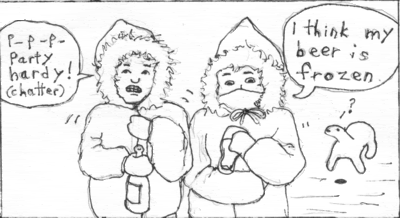 I am pretty sure that this expression started out as "party hearty," with a t. But in North America, t's tend to be pronounced as d's, so that "party hearty" and "party hardy" sound the same. And in a society where sense is not expected, it doesn't matter that "party hearty" means "to party with gusto" and "party hardy" means, one can only suppose, "to party in difficult, inclement conditions." So when the expression got written down, "party hardy," whimsically nonsensical and having one letter fewer, won the day.
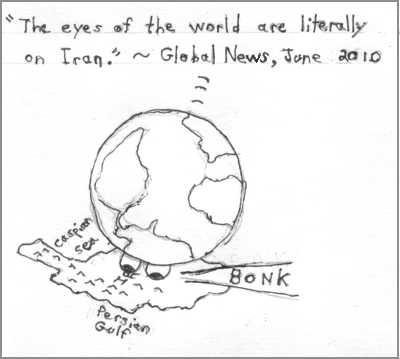 Global News did this. "The eyes of the world are literally on Iran," the broadcaster said. No, the eyes of the world are figuratively on Iran.
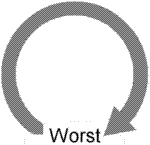 If worse comes to worst. That's the expression, OK people? Really, a better expression would be, "if bad comes to worse." Maybe that's what the expression used to be, and people didn't think that was strong enough. But at least, "if worse comes to worst" makes some kind of sense. Things got worse, and then they got as bad as they possibly could—the worst. "Worst comes to worst," on the other hand, makes no sense at all.
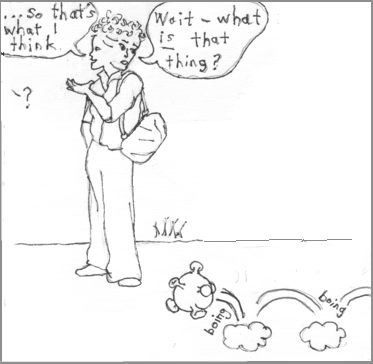 Another thing! You've got a thing coming. I love that. It's so idiotic, it's good. And no less an intellectual than Susie Bright used this expression (in her article about Camille Paglia: "If you think Pat Buchanan calls up Hurricane Camille for strategy sessions, you've got another thing coming"