Showing posts with label weirdness. Show all posts

Wednesday, April 15, 2015

I ate cricket! (In chip form, mind you)

We had a treat for lunch today: my cricket chips, which I pre-ordered way back in mid-winter, arrived this morning. Amusingly called Chirps, these chips come in three flavours and are the creation of a new company called Six Foods.

As you can see in the picture, the chips came with a nice canvas tote bag. I quite like the slogan on it: "Bug Appétit." I'll definitely be carrying that around in public! Also included was a sweet handwritten letter, thanking us "Bug Lovers" for supporting the company, and also providing some interesting information on their process from dream to product:

We've worked with a food pilot plant for eight months to create the recipe & it has been a huge learning experience for us. We've experimented with 50 different recipes, obscure ingredients (teff anyone?), and called over 400 manufacturers till we found the right partners.

Thank you for being patient with us through this process. As a token of our love + appreciation, there's an extra Six Foods tote for you.

Bug Appétit!
Laura, Meryl, + Rose

Wow, Laura, Meryl and Rose, you are some hard-working entrepreneurs! Good for you.

The Chirps packaging advertises that Chirps contain "3X more protein than regular potato chips," but really, they should be compared not to potato chips but to tortilla-bean chips. So I'm doing that. According to caloriecount.com, Kettle Tortilla Black Bean chips contain 3g of protein, 18g of carbohydrates and 7g of fat. Beanitos are another chip worth comparing with, as they also contain beans, although not corn. According to the Beanitos web site, Black Bean Beanitos have 4g of protein, 15g of carbohydrate and 7g of fat. Chirps chips contain 6g of protein, 12g of carbohydrates and 6g of fat. So yes, Chirps win, in terms of having the most protein. They also have less fat and a better carb to protein ratio.

At this point you may be thinking, "Never mind all that, how do they taste?"

When I ordered Chirps, I opted for the variety pack so that we could try all three flavours: natural, cheddar and BBQ. So we had to decide which one to open first. I thought the natural bag first would be a good choice, as it would allow us to better appreciate the unadulterated flavour of cricket. So we did that, and... they're quite tasty. Better than original Beanitos, I would say. They have little black dots in them, but those are the chia seeds, not the crickets. No visible bits of cricket can be detected in this product, so if you're squeamish about that, you can set your mind at ease. They look and taste somewhat like tortilla bean chips, but with a slight difference, and I'm not sure how much of that is the chia seeds and how much is the cricket. Also, they are stiffer and crunchier than the typical tortilla chip. In terms of hardness, they remind me of Mary's Crackers.

So I can recommend Chirps by Six Foods as a gentle introduction to the world of bug-eating for anyone who would like to take the plunge but is not ready to stuff a whole cricket or mealworm in their mouth, a la Millennium Farms. That's quite advanced for us weeny Westerners, and I'm happy to leave that for later.

Ingredients in Chirps, Natural Flavour

  • Navy Beans
  • Sunflower/ Safflower Oil
  • Corn Flour
  • Chia Seeds
  • Pea Flour
  • Cricket Flour (Gryllodes Sigillatus and/or Acheta Domesticus)
  • Salt

Allergy Alert

The Chirps packaging advises that "If you have crustacean shellfish allergies, you may also be sensitive to crickets."

Monday, April 26, 2010

Silliest New Product Award 2009

Once again, the time has come to bestow the Silliest New Product Award. A long time has passed since I last gave out this award, for Bagel-fuls. But please understand that this award is not just for any minor foolish product. If it was, I could give it out weekly. But no--a Silliest New Product must scale the Everest of foolishness. And at last, we have a contender.

Once again, the product in question is a food product. I will have to start keeping an eye out for foolish devices or articles of clothing. I don't want to limit myself to food, although admittedly it's something I get passionate about. This food product is even sillier than Bagel-fuls was. It add a whole new dimension to silly food, in my opinion. There's no denying that our society is loaded with silly food, even dangerous silly food. Yes, we keep trying to find ways to stuff more caffeine into our beverages. Yes, our desserts are so sweet that sugar is often the first ingredient. And let's not forget poutine.

The thing is, though, we know that that sort of stuff is junk food. People may joke that poutine is a meal, but they don't eat it as such too often, unless they actively want to die young. As much junk food as we eat--and we eat a lot of it--at least we are aware, however dimly, that it's not a real meal, and not something we should be eating very often.

But what if some daring and black-hearted individual should redefine the meal? What if you could eat something that was incredibly bad for your health, but still feel as if you'd had a perfectly adequate meal and were not doing anything wrong? For such is the cunning of my award recipient that he, whoever he may be, has entirely redefined the concept of "meal" in just such a revolutionary way.

Oh, we've had meal redefinition before. Don't get me wrong. I am aware of the bold stroke that created the TV dinner: meals apportioned out in a partitioned foil tray. (That was before the advent of microwaves, of course; now it's a partitioned plastic tray.)

Still, the TV dinner, and its offspring, the nukeable dinner, continue to give lip service to the idea of food groups. Some form of vegetable matter still constitutes part of the meal. Said vegetables may be limp and tasteless and people may not eat them, but at least they're there.

Then there's the junk food meal, with its three food groups: hunk of meat with filler, bun, and fries stuffed into a little cardboard packet. Admittedly, the vegetables are absent, but at least some degree of food groupage remains. Also, look at the name. We recognize that this is junk. We don't take it seriously. That's important. In this age of rising obesity and diabetes rates, it may be little enough to hold onto, but it's something.

The real coup has come with the throwing out of food groups altogether. Now, it seems, we are ready to accept the concept of a meal consisting of just one food group, and in a form almost totally devoid of fiber and nutrients. At least, somebody thinks we are, and frighteningly enough, he may be right. It is a stroke of Lex Luthor-like genius. Ladies and gentlemen, I give you... drumroll, please... Domino's Pasta in a Bread Bowl.

That's right. What's pasta made of? White flour. What's the bread bowl made of? White flour. So you have a situation where someone can consume a great big lump of refined flour product with a little bit of creamy sauce on top (also containing white flour) and consider that he or she has eaten a meal.

This is bad, folks. This is very, very bad, although perhaps it is the logical end of decades of addiction-fueled, simple-carbohydrate binging. But I don't think we can just blame the consumer in this instance. I refuse to believe that Domino's has been hounded by people crying, "Stop serving us our pasta in real bowls--we want it in pizza dough! It's the only way we can get enough bready stuff!" No. I think what's going on here is that Domino's is actively trying to kill us.

This brings up the question: Why is Domino's trying to kill us? My best guess is, for the fun of it. I think they're serving up those bread bowls and then hunkering down like Kilroy and peeking through the little window where the waitresses leave the orders, watching as the customer eats his "meal" and giggling maniacally to themselves. Perhaps saying things like, "Oh my God, he's eating it! What a moron!" Much like Colbert Report viewers did when that suicidal guy ate a fifteen-pound burger.

Now, you may argue that this is a shortsighted way to do business. Sure, you have a little fun watching the mayhem. Sure, your customers' addiction to simple carbohydrates gets even worse, and you do a brisk business for a while. But then they die, and where is your business then? OK, there's a new generation, but if they do the same thing, they'll die untimely deaths as well, and eventually the shrinking population is going to impact your bottom line, right? It's not a good long term plan, is it?

To which I'd respond, hey, it's worked for the producers of cheap alcohol. So far, anyway. And let's face it, most businesses are based on short-term gain. Hell, the whole economy's based on short-term gain. That's why nobody wants to do anything about global warming.

But I sense myself drifting off-topic, so let me just return to the point and say, Dominos, you suck. Once, you seduced me with your Extravaganza pizza. But with Pasta in a Bread Bowl, I have lost all respect for you.

Thursday, September 3, 2009

A message from prot?

Here's a curious piece of synchronicity. While we were in Grand Manan, we paid a visit to the local library and James found a copy of K-PAX. Remember the K-PAX movie, about a guy in a mental hospital who calls himself "prot" and insists he's an alien from the planet K-PAX? Well, it was a novel first. In New Brunswick we have this nifty system where all the libraries are on one network, and we can use our cards anywhere in the province, so James checked the book out of the library.

In the movie, prot says he's returning to K-PAX on July 27. In the original book, the date is August 17. It's repeated several times: pyschiatrist Gene Brewer (who just happens to have the same name as the author) has very little time because of this cut-off date, August 17. Well, take a look at this slip, from the library book, and see what the return date was.

Coincidence? What are the odds? No my friends, this is a message. Prot lives! See you on K-PAX.

Friday, July 24, 2009

Fredericton's Architectural Atrocities: A Tour

Founded in 1783, New Brunswick's capital city is replete with beautiful old architecture of a range of periods and styles, from Georgian to Victorian and beyond. When people and places are fortunate enough to have an abundance of something, there is a tendency to take it for granted. The scars of this attitude are visible all over Fredericton, where few people think anything of busting a hole in the side of a grand old home, church or other building so that they can put up some tasteless but convenient addition.

That is why I am proud to offer the only tour of Fredericton's Really Bad Architectural Decisions available either online or off. At the end of the post, you will find a map of this walking tour, suitable for printing, so that if you are ever in Fredericton, you can get the full experience. In the meantime, I hope you enjoy this virtual tour.

King's Place is a good spot to begin, as it is right in the centre of downtown, and all the buses stop there. Let's gather at the side door, where the pharmacy is located, and begin to walk south down York Street.
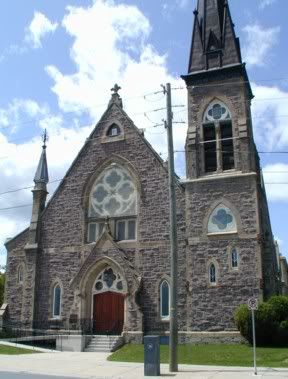
Crossing Brunswick Street and York Street, the first notable piece of architecture we come to is the Brunswick Street United Baptist Church. I believe this would be considered an example of Gothic revival. You can see that it has a tower so tall that I couldn't fit it in the picture. It's not my favorite--that would be St. Paul's United Church, just a short way down the street--but it's still quite an attractive church.

However, keep walking, and you will soon see that something odd is attached to it.

It's not a terrible piece of architecture in itself. It bears some slight resemblance to York House next door (not shown here because it's not part of the tour, but if you want to see a picture of it, click on the link). The one thing it does not resemble, in any way whatsoever, is the church to which it is attached. Not that I think that would make it OK. Putting an addition on a lovely old church is tasteless and wrong, period. But if you're going to do it, the least you can do is make some effort to make it match. That was not done here. Indeed, it appears to be part of this church's tradition to show utter disregard for historical structures. That building next door I just mentioned, York House? They wanted to tear it down, and the city had to buy it to prevent that happening.

Let us move on from this unfortunate church. At the next corner, look across George Street and you will see my favorite church in Fredericton: St. Paul's United Church. It is quite similar to the Baptist Church, and I don't know why I like it so much better. I just do.
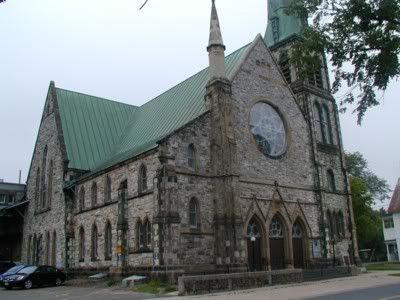
According to the plaque out front, St. Paul's was built in 1886 (in the same time period as the Baptist Church, which was built in 1883) and is "a fine example of High Victorian Gothic Revival architecture." Indeed it is. Unfortunately, that's not the only thing it's an example of, as you'll see if you continue down York Street:
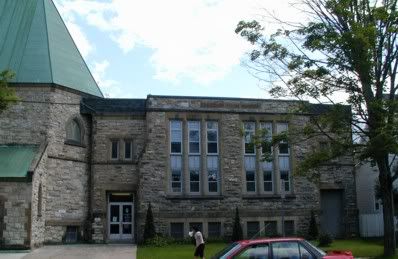
Here we can at least say that some effort was made to make the addition match its host. Although the new structure's windows are rectangular in contrast to the original church's arched windows, and it has the flat-roofed stumpiness of all additions, the stonework is similar. Still, there is no getting around the fact that the effect is not at all what the architects of the original church had in mind. Earlier on, I mentioned the tall towers that are a feature of this kind of church. These, the pointed arches, and other features of a Gothic-style church are meant to draw the eye upward, towards God. Stick a stumpy thing on the church's side and the effect is much diminished. Further, Gothic churches like this are constructed in the form of a cross. The addition interferes with that effect.

Still, it could be worse. And later in the tour, it will be.

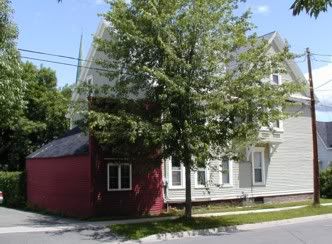
Continuing down York Street, we come to Charlotte Street. Turn right and walk down Charlotte for a block. You will see many nice old houses, and if you take care to look between the houses, you will see many additions. Here's an entertaining example from the corner of York and Charlotte. Usually, additions are at least the same colour as the host house. Not so here, and that's not the only odd thing. There is a tree in the way, but if you look closely, you will see that although the addition has a sloping roof, the wall at the edge of the sidewalk is rectangular. It's a false front, like something out of a frontier town. Just plain weird.
Now we come to Westmorland Street, and our final church. (I didn't mean to squash all the churches to the front of the tour; it just worked out that way.)

On the right in the photo below is St. Anne's Chapel of Ease, which dates back to 1847. Like the other two churches, it is an example of Gothic Revival, though because it is a chapel, it lacks the towers and cruciform structure we saw earlier. You can't see the stained glass windows from the outside, as they are covered, but they are visible on the inside and are beautiful, as is the rest of the interiour. Do go inside if you get the chance. There are free tours on offer during the summer.
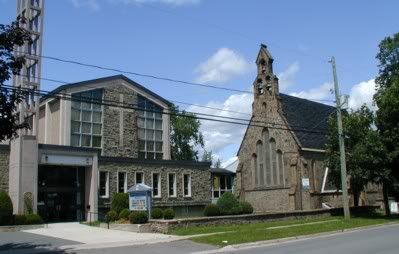
On the left is the Christ Church Parish Church, built in 1962. It is not beautiful. It does have a tower, which looks something like an electrical pylon. Well, there's no help for that, is there? The congregation grew too big for the old chapel, so a new church had to be built. And it would never be beautiful like the old one because, let's face it, we are living through an architectural dark age. So what could they have done differently?

Here's what: they could have made the new church a completely separate structure. In fact, the new church is attached to the old chapel. If you look closely at the photo, you will see the walkway that connects them, making the new church a kind of immensely bloated addition.

There's no way to do something like that without damaging the old structure. From the inside of the chapel, you can see that one of the stained glass windows has been shortened from the bottom to make room for the door to the addition. The bottom of the window is gone, and the chapel has been diminished--in a small way, perhaps, but diminished nonetheless. And all to permit people to walk between the two buildings without going outdoors. One would think this was done because of our cold winters, but the old chapel isn't even heated! What was the point, then? Why did they do it?

I suspect because it never crossed their minds to do otherwise. Additions are a way of life in Fredericton, and therefore are seldom recognized as the acts of vandalism they so often are.

Continue up Westmorland Street, and turn right at the next corner. We are back on George Street, which like Charlotte Street has many fine old houses with strange additions. I particularly like Number 329. It's a great example of the Serial Additions Phenomenon.
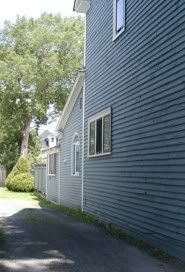
An addition is generally smaller than whatever it is attached to, so when there is more than one addition, you can get a sort of regressive effect, as here. The last and shortest thing you can see at the end is probably a deck, or a fence around the backyard.

Crossing at York Street, we're back at St. Paul's United Church. This time, we're passing it on the other side, and you can see that the addition is large enough to stick out quite a bit at this end as well.
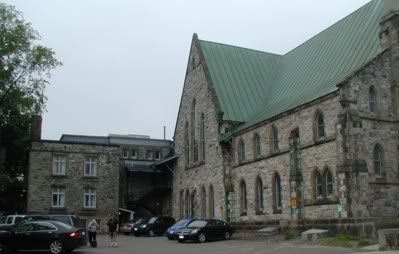
We now have a couple of long blocks to walk before we get to the next notable addition, so have a look around at all the old houses on George Street, and their peculiar additions.

Once across St. John, we come at last to 734 George Street. At first glance, it's a stately Georgian-style home. But wait, what is that puke-coloured stripy thing on the side?
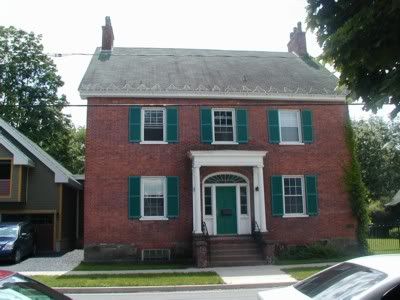
No. Can it be? It is! Somebody took a nice old brick house and attached a garage on one side, and some sort of other thing on the other, and painted them... green and red with amber trim! And to top it off, there are those triangular... I guess decorative elements, for lack of a better word, coming off the eaves.
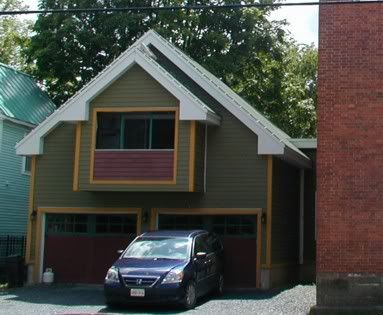
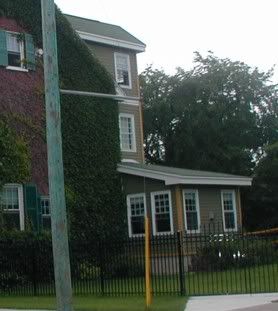
These structures don't even look good on their own, much less stuck on the house. The tastelessness is breathtaking. It's so bad, it's almost good, in a sick sort of way.

This house went on sale a few years ago. The owner was so proud of what he'd done to it that his asking price was half a million. I recall that it was on the market for some time. The best part of this was the picture on MLS of the back view of the house, with its horrible yet hilarious addition. I emailed the link to my family and we all laughed our heads off.

On the front of the house is a plaque. Here is what it says:

The Rectory 1829
This Georgian residence, built by St. Anne's Parish Church for the rector, was the home of the famous literary Roberts family.

This is when the laughter dies. This house is a heritage site, and the city still let the previous owner do this to it. It's disgraceful, but apparently rich people can do whatever the hell they want.

Let's have a moment of silence and retrace our steps a little bit. Back to St. John, turn left, walk to the end of the block and turn left again. Now we're at the other end of the block, and can get a little glimpse of the back end of the house, in between Numbers 719 and 729. (Yes, they're consecutive. Don't ask me why they're numbered that way; ask the city.)
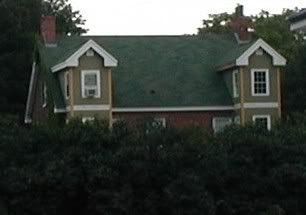
I wish I'd had the foresight to save that MLS picture, but I didn't. This is the best I can currently do to show you the magnitude of the addition. You can see the top, but the bottom is obscured by a hedge. Perhaps in the winter I will be able to obtain a better picture. Still, look at those two tower/dormer-window things jutting up, remember the two other pieces you saw before, and keep in mind that they are all connected. No kidding, that's one big monster, stuck on the back and wrapping around like a parasite feeding off 734 George Street.

Let's move on. I can't say "the worst is yet to come," because that was pretty bad, but the next one is pretty bad too. It's hard to say which is worse.

Continuing down Charlotte Street, we come at the next corner to Church Street. You'll spot the next site as soon as we round the corner; it's hard to miss. Right across the street is one of Fredericton's most beautiful houses.
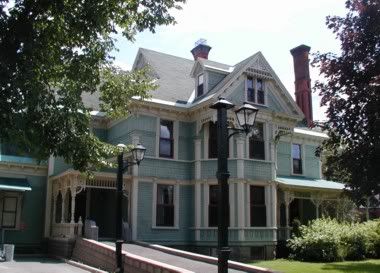
811 Charlotte Street was built in 1895, in a style called Queen Anne. Look at the trim on the eaves and the veranda. It makes me happy just to look at it. I've been inside, and the interior is even more spectacular.

However, when we turn left and walk up Church Street, we see this.
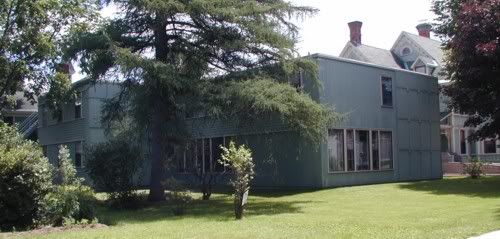
This irregular, boxy affair with its ridges, inexplicable window configuration and overall unwholesome appearance would be ugly all on its own. It becomes all the more hideous when you realize it's attached to 811 Charlotte Street.

811 Charlotte Street currently houses the University of New Brunswick's Renaissance College. Prior to that, it was a student residence with 21 beds. Since it would be difficult to fit 21 beds into one house, the addition must have been built at that time. It is remarkable that something that ugly could have been built in 1949, the year that the house became a residence, but the conclusion is inescapable. The architect responsible should be thoroughly ashamed.

Fortunately, we have a bit of a stroll to get to the next site in the tour. That will give me the opportunity to calm down. Proceed North on Charlotte Street for another two blocks, past Christ Church Cathedral on Brunswick Street, make a left at King and a right at St. John. This will bring us in view of the Fredericton Playhouse at the corner of Queen's Street.
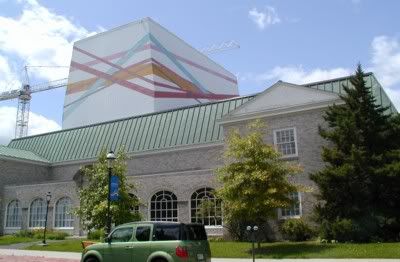
Although it is, for the most part, a reasonably attractive building, the Playhouse is not a heritage site, having been built as recently as 1964. So we don't have to feel too bad about the fact that it has a great bloody rainbow-striped box sticking out of its roof, and we can enjoy a hearty laugh at its expense. The box was added in 1972. It is a fly tower, a space used to house draperies, lights, set pieces and other equipment that can be lowered into place when in use, and raised back up into the tower afterwards. It sounds quite useful, but again, could they not have tried to come up with something that would match, at least a little, the original building? Instead of making the Playhouse look like a nest for a giant bird that laid a square Easter egg?

I once saw the Playhouse addition figured in a pamphlet on Fredericton's outdoor art. That's right, folks, somebody thought the rainbow box was art! Or pretended to.

Speaking of boxes, we have one more stop, so let's turn left on Queen Street and walk three blocks, to where Queen intersects with Carleton. Across Queen Street you will see another heritage building.
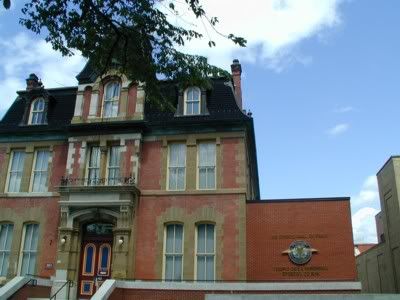
This lovely old structure dates from 1881. The original part is Second Empire style. The addition is Modern Brick Box style. Back in the 19th century, this was the Post Office and Customs House. In 1970, it became the New Brunswick Sports Hall of Fame. That date sounds about right for the brick box. Let's take a closer look at it.
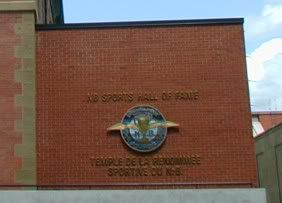
As you can see, it has an attractive crest right in the middle, as well as some lettering that reads "NB Sports Hall of Fame" in both official languages. That was a clever touch. Without the crest, anyone who looked at this addition would immediately think, "Why is there a brick box sticking out of the side of this nice old building?" But with the crest, your eye tends to glide on by. It takes time and many viewings, preferably from different angles, before you become aware that, crest or no crest, you are seeing a graceless brick box sticking out of a heritage structure, and that this involved making a hole in the side of the building and eliminating the windows that used to be there. You become aware that this damage, so cavalierly done, probably can never be undone. The architectural tumour is inoperable.

On that cheery note, this is the end of the tour. If you'd like to return to the spot where we started, you can either continue on Queen Street until York Street, then make a left and walk one more block, or you can turn left here, onto Carleton. Which way is better depends on which post-tour beverage you'd rather ingest. If you'd like something with whipped cream and drizzled chocolate, there's a Starbucks in King's Place at the Carleton-Street end. If you'd prefer an actual coffee, I recommend taking the York Street route. That way, you can get a good coffee at Read's magazine store, right across the street from King's Place.

Enjoy the rest of your day.


And here, as promised, is my walking tour map. Be sure to change your print setting to Landscape before printing.

Friday, March 27, 2009

Tumbarumba, the Random Story Dispenser

If you use Firefox, enjoy reading science fiction and fantasy stories (especially free ones!) and don't mind surprises while surfing the web, you should consider giving Tumbarumba a try.

Tumbarumba is an art project and Firefox add-on that comes with twelve stories. When it is first installed, the stories are inaccessible to you. You need to unlock them, one by one, which you do by doing what you usually do with your browser anyway: surfing the web.

Tumbarumba looks through the web pages you access for words that are also found in its twelve stories. When it finds a match, it splices the rest of the story's sentence to the beginning of the web page's sentence, producing a new sentence that is syntactically sound but doesn't make much sense.

To take an example from my own Tumbarumba-tinted surfing, the Tales of the Talisman's web site contains this sentence:

The hadrosaur talisman logo is inspired by a duckbilled dinosaur called a tsintaosaurus.

As well, the Tumbarumba story "The Little M@tch Girl" contains this sentence:

As Nera tossed him his fare, he called, 'Have fun, little sluts.'"

The word common to both these sentences is "called." So when I came across the Tales of the Talisman web page, I was faced with this puzzling declaration:

The hadrosaur talisman logo is inspired by a duckbilled dinosaur called "Have fun, little sluts. [sic]

When you come across one of these gibberish sentences, you can either conclude that the writer was smoking some bad weed when he wrote it, or that your Tumbarumba has kicked in. To find out which is the case, slide your mouse pointer over the anomalous sentence. If it changes to a link pointer , that's Tumbarumba. Click, and the add-on will insert another chunk of story text. If you keep clicking, eventually (in my experience, it varies from one to five clicks) the original web page text will fade out and the story will fade in.

Tumbarumba stories don't have their own web pages. The only way you can read the twelve stories is to allow them to hijack the web pages you are reading. The story text is forced into the format of the web page, sometimes with awkward results. I had one story that began in the thin left-hand column where the original web page had had its menu. Another story took over a form, which resulted in the story text being interrupted by fields. If you don't like the resulting format or find it unreadable, just wait, and eventually that same story will hijack a different web page.

To go back to reading the original web page, open the Tumbarumba pull-down menu in your Firefox browser, and select "Disable Tumbarumba on this page."

If you go to the Tumbarumba Table of Contents, also accessible from the pull-down menu, you should find that the story is now unlocked; that is, it is no longer plain text but is clickable. (Should: Tumbarumba does have bugs. See below.) One thing I haven't figured out yet is whether clicking just once on the gibberish sentence will unlock the story, or whether you have to keep clicking until the story hijacks the page. I suspect it's the latter but haven't experimented enough to be sure.

Obviously, this add-on is not for everyone. Some people would find it annoying. However, there's no risk involved in trying it, as you can always turn it off completely, again via the pull-down menu.

I have unlocked seven stories so far, and gotten around to reading three and a half. (The fourth was not to my taste.) Mostly, they're quite good. "Little M@tch Girl," a futuristic retelling of the Hans Christian Anderson classic, could haunt your dreams.

But the stories are not the only pleasure Tumbarumba has to offer. There's also the experience of coming across a sentence that produces a mental double-take. I've found it interesting to observe my brain's reaction to these sentences. First, it tries to go on reading, thanks to that built-in mechanism we all have in our brains that glides over anything that doesn't compute. This makes us more robust than those women robots encountered by the Starship Enterprise, that would break down when faced with paradoxical or nonsense statements.

So I tended to read on for a couple of sentences, then think, wait a minute, and rewind to the offending sentence. I'd reread it a few times and wonder what the author had been thinking. Only then would I remember: oh yeah, Tumbarumba. But this reaction varied if the sentence made sense in a whimsical sort of way. When I saw the dinosaur sentence mentioned above, my first thought was, "What a silly name for a dinosaur!"

I have since found that as I get more accustomed to the effect, I become quicker and quicker to recognize the gibberish as the result of Tumbarumba. Recently, I've even been able to skip the whole double-take routine. I kind of miss it. It's a reminder of what a small piece of reality we normally perceive. I also like feeling the shift in perception that comes at the moment of understanding. It feels like a bit of enlightenment.

Happily, I can still be tripped up in certain situations. Recently, I was searching the provincial government's web page for information on their latest budget, as research for my blog post on the subject. I read that the budget "provides Leadership for a Stronger horizontal," and laughed with glee at the lengths to which officials will go with their obfuscating jargonspeak. I had no idea what was meant by "a stronger horizontal," but I didn't doubt for a moment that it was something that would be put on a government web page. Like other inhabitants of modern society, I long ago abandoned the expectation that government officials would make sense, either linguistically or ethically. I decided to copy the sentence, because it was so funny, and it was only when the mouse pointer changed to a link pointer that I realized, at last, that I'd been Tumbarumba'ed.

The original phrase was actually "a budget that provides Leadership for a Stronger Economy." OK, that does make slightly more sense, even if it's hard to imagine how a budget can provide leadership.

To download Tumbarumba and try it yourself, go to the Tumbarumba home page and click on "Download." Note that you have to have Javascript enabled in your browser to navigate the home page.


Bug Notes: After I'd unlocked my first Tumbarumba story, I found that the hijacking mechanism kept failing. The original web page would fade out, but the story would not fade in, nor would it become clickable in the Table of Contents. I contacted support, and was told that there was probably something about the web pages that was interfering with Tumbarumba. I found this unlikely, since it had happened three times in a row. When I went back to the one story I'd unlocked, I found that I had disabled Tumbarumba on that page. I enabled it, and after that everything worked fine. This leads me to conclude that there is a bug in the disable mechanism, though the support guy might not agree with me. I feel even more certain of that since the most recent story failed to unlock in the Table of Contents. I had disabled that page as well. So if you have problems with Tumbarumba, try enabling all the disabled pages and see if that does the trick.

Thursday, March 12, 2009

My Weekend In Prince Edward Island

I may not be in primary school anymore, but that doesn't mean I can't write about What I Did On My Summer Vacation. It may be an odd time of year for it, but keep in mind I only started this blog in December.

We were only there for a weekend and had time only to see a tiny fraction of PEI, so don't take this as a comprehensive review, but my favorite spot was the national park in Cavendish. Lucy Maud Montgomery, author of Anne of Green Gables, was also fond of it, and is quoted on some of its placards. From a boardwalk leading through a marsh, you can see a tremendous array of life. When I saw that parts of the water were bright green, I was at first concerned it was an algae bloom. On closer inspection, the green carpet turned out to be made up of thousands of tiny plants that floated on the water. I'd never seen anything like it before. I still don't know what it was, since they had no placard for it.

Close by the marsh is a beautiful beach where the famous red sand and sandstone cliffs are on full display. Though it was July, you could only wade into the seawater for half a minute before the ache of cold in your bones would send you running screaming back out again.

Don't expect me to continue in this cheerful vein; not as long as there's something to complain about. I don't call this blog Kvetch of the Day for nothing.

I think PEI must be located in some sort of Canadian version of the Bermuda Triangle. What I mean, if you will excuse a brief slide into vulgar colloquialism, is that there is some weird shit going down over there.

Foremost of which is the tendency of shopkeepers to peel the "Made in China" stickers off their merchandise. When I first saw this, it was in a restaurant in Cornwall that had a few touristy items for sale at the counter: little wooden boats, doodads with shells glued on, that kind of thing. I picked one up and turned it over to discover paper and glue remnants in a partial oval. This surprising discovery led me to turn over all the knick-knacks. One or two still had their "Made in China" stickers; all the rest had been peeled.

I thought it must have been an oddity of that particular restaurant until we went to another restaurant, a huge slop-dishing affair in Cavendish with a gift shop attached. I don't know what possessed me; maybe it's just what I do in stores because I like to know where things come from; in any case, I turned their souvenirs over and found the same thing.

Excuse me, but isn't this illegal? Those stickers are there for a reason. People are entitled to know where their purchases came from. What possesses shopkeepers to do this?

I decided that the shopkeepers must be embarrassed that their souvenirs of P.E.I., seashells and all, were manufactured at the other end of the planet. I wouldn't blame them--for the embarrassment that is--but a better reaction would be stock locally-made souvenirs. Then they wouldn't need to engage in shameful, furtive sticker-picking.

This theory took a bit of a beating when I purchased a metal water bottle at Moonsnail Soapworks & Nature Store in Charlottetown. A very untouristy item, yet when I turned it over... I think you can guess what I found. In fact, you can see it in the picture. PEI has several symbols, including a provincial bird (blue jay) and a provincial flower (lady's slipper), but if they want something that will capture the essence of the tourist experience in PEI, they should consider adding the vaguely oval glue-and-paper smear to the list. I hereby offer this photo to the PEI government for consideration.

The effect of Canada's Bermuda Triangle on the human brain is indeed mysterious, as was brought home to me yet again when I forgot my bathrobe in the room we'd rented at Obanbrae Farm Bed & Breakfast. I called the hostess a couple of days later, only to be told she'd already thrown it out. She didn't even give it to a charity shop. At least then I would have the satisfaction of knowing that somebody somewhere was getting use of a bathrobe that was still in perfectly good condition. But no, I suppose that would have taken up to much of her valuable time, and nothing that did not belong in her neurotically neat domain could be permitted to stay there for more than a couple of days. So into the garbage it went.

Another big surprise was the driving in the Charlottetown area. The sheer number of times you get cut off in a single journey is astounding. It was like driving in Montreal--also an island. Is there something about islands that makes people drive badly? You would think they'd be afraid that their fellow islanders would get fed up and pitch them into the surrounding sea or St. Laurence River. Come to think of it, that's not such a bad idea.

The bad behaviour does not necessarily come to a halt when the vehicle does. James and I stopped at a roadside stand to get junk food. An elderly couple arrived in a truck. The old man parked and left his wife in the idling truck while he bought two ice creams. I expected that he would drive away and eat the ice creams on the road. Instead, he and his wife sat in the truck licking their ice creams, while the truck continued to idle, rumbling pollution into the parking lot so that everyone else lined up at the stand could enjoy the fumes.

After ten minutes, my brain was sufficiently addled by exhaust that it seemed like a good idea to ask him why he was doing this. The influence of the Canadian Bermuda Triangle might also have been a factor. I walked up to the truck and tapped on the driver's side window. He rolled it down.

"Hi," I said. "I'm just wondering why you're idling your motor."

"I don't know," he said. "Why?"

So I enumerated the drawbacks as I perceived them: pollution, noise, waste of gas and money. I finished by saying I couldn't understand why he was doing it.

"No," he said, "I don't expect that someone like you would."

I was still chuckling over this clever witticism when he informed me indignantly that he had to idle the motor or it wouldn't start again.

"Oh," I said.

"And it's none of your business anyway!" said his wife, glaring at me as her husband rolled up the window.

"I just asked a question," I protested through the ever-narrowing gap in the window, but the woman continued to glare at me. So I gave her the finger.

Later, having had some time to think it over, I decided the old goat was probably lying through his teeth. There was a garage a short distance from the food stand. Any sensible person with a non-starting truck would take it to the garage before going for ice cream. If he'd had such a hankering for soft-serve, he could have walked over and bought some while they worked on his truck. Besides, his first response was that he didn't know why he was idling. I suppose he had time to cook something up while I talked.

Why even bother to come up with a story? Why not just say, "I feel like idling my truck. I don't give a damn about pollution. Go away,"? It could be he lied because I'd caught him out and he was feeling embarrassment, much like the merchant peeling "Made in China" stickers.

We spent most of our time in Charlottetown, which in retrospect was a shame. It hasn't got a lot going for it, other than Province House, which is OK. The downtown core consists of restaurants, mostly mediocre, and boutiques which seem chi-chi until you go inside and discover that they're full of merchandise from China with the stickers peeled off. The Chocolate Factory has a lot of mediocre chocolate that is mostly sugar. It is attached to The Anne of Green Gables Store, the ultimate destination for Anne fanatics. (Maybe they should be called Anneatics?) At a nearby theatre, you can see Anne of Green Gables: The Musical, which costs as much as an opera and doesn't have any good songs. You can save a lot of money by hanging out in the Anne of Green Gables Store, where they play the soundtrack. Stay there long enough and you'll hear the whole thing.

It may be PEI's capital city and it may be comparatively near the Confederation Bridge, but Charlottetown is not where you should spend a lot of time in PEI, especially if you're there for a short time as we were.

Speaking of the Confederation Bridge, I'm sure it is a marvel of modern engineering and blah blah blah, but I wish they hadn't built it. They used to have a ferry that went that way. For the same price ($40) we could have been on the water, enjoying the salty spray that they sing about in Anne of Green Gables: The Musical. Instead, we spent ten minutes--and felt every individual minute--staring at a strip of grey cement running off into the empty sky. There is no more boring drive in the world. So what if it's quicker? People need to get over the idea that quicker is better. And they need to make a similar mental shift with regards to "bigger," as exemplified by the hideously inflated tourist "village" that awaits you at the other end of the bridge. That's another wonder of modern engineering that should never have been built.

But to return to my point--don't waste your trip by spending any length of it in the Charlottetown area. Spend your time at the beaches and parks. Our trip improved noticeably when we headed north to Cavendish, and I wish we had sooner. We did not have time to see all the sights in the area, such as Montgomery's house. Next time I think we will immediately head north after crossing the Confederation Bridge, and stay there.