Showing posts with label travel. Show all posts

Wednesday, August 22, 2012

McCabe's: New Brunswick's finest ice cream is found by the highway in the middle of nowhere

Postcard

It probably seems out of proportion to get in the car and drive 40 minutes for ice cream. But this is no ordinary ice cream.

My husband found out about the place on a drive to Moncton a year or two ago, when he saw their road sign and popped in for some vanilla. He remembered it favorably enough to mention it to me one Friday evening in July, when the subject of ice cream came up. He thought it was about 20 minutes away.

My reaction was, hey, if it's that close, let's jump in the car and go! James demurred. It was evening. They might only be open in the daytime.

We tried to find out the telephone number, so we could call and find out their business hours. There was no entry under the Yellow Pages category Ice Cream & Frozen Desserts—Retail. We tried the Internet. There were some forum references to McCabe's, but no web page and no business hours. Likewise, yellowpages.ca had no entry for McCabe's. This business was unlisted! Whether this was some strange oversight or the place simply had no phone, there was no telling, and nothing to do but go there in person. But not that evening, especially since Google Maps' directions indicated that James' estimate of the distance was off by 100%: not 20 minutes, but 40.

It had to wait until Sunday. In the interest of pretending that this was not just an unusually long ice cream run but a whole day trip, we did some research on the area. Cambridge-Narrows is the closest town. Its tourism web page consists largely of a well-nigh unreadable scan of their brochure, 14 Things to Do in Cambridge-Narrows. At least it had a tourism web page. And a lake, so possibly there would be swimming. I threw a bathing suit, towel and cooler (in case they sold pints and we wanted to take some home) into the trunk, and off we went.

MCcabe's might not have a web presence, but their highway presence is more than adequate. The big sign at the side of the road is hard to miss, with its flashing yellow lights in the shape of an arrow. James pointed this out to encourage me, as I'd spent a substantial part of the drive fretting about the fact that it was Sunday, and things tend to close on Sunday in New Brunswick. Try going to Saint John, one of NB's biggest cities, on a Sunday. Almost nothing will be open. "How do I manage to forget this every time?" I'd lamented. "We'll have driven 40 minutes for nothing," etc., etc.

"Look, the arrow's flashing," said James. "That means they're open."

A further aid in guiding drivers is a red balloon, floating high in the sky above the spot.

After the sight of the giant sign and balloon, it felt incongruous to round the corner and see the tiny beige house. Outside, it didn't look like much. Inside, they offered a tiny selection of seven flavours. The menu was divided into regular flavours—vanilla, strawberry and chocolate—and the more expensive gourmet—coffee, mocha, raspberry and maple cream.

I mulled over the gourmet options but since none of them appeared to contain chunks of things, I chose that old standby, chocolate. James chose vanilla, the same flavour he'd had the last time.

I tasted my ice cream. OK, I thought, worth the trip. Maybe that's as much a comment on Fredericton ice cream parlours (or should I say ice cream parlour?) as it is on McCabe's. But my scoop was creamy with a rich chocolate flavour.

But I hadn't tasted nothin' yet. James offered me his vanilla, and then I knew I was in the presence of greatness. There was an explosion of vanilla bean on my tongue.

Honestly, I've never had a vanilla ice cream to equal McCabe's. Not Haagen Daaz. Not even Ben and Jerry's. And I still hadn't tasted nothin' yet. But more on that later.

The place is run by a smiling elderly lady with an accent that I couldn't place. I never found out her name, so I will take a chance and call her Mrs. McCabe. I asked Mrs. McCabe about pints. They don't sell them. If I wanted to take some home, my only option was two scoops in a styrofoam container.

I decided to get gourmet flavours, since we hadn't tried them yet: one scoop of mocha and one of maple. As Mrs. McCabe excavated our scoops, I asked about hours. McCabe's is open from 9:30 in the morning til 7 at night, seven days a week, from Victoria day to one week after Thanksgiving. Mrs. McCabe remarked that some of their customers buy a whole vat of ice cream, of the sort that the scoops come out of in the shop, so that they can have ice cream all winter. I have it on good authority from my ice-cream-fanatic father that those are three-gallon vats. One vat costs between 70 and 80 dollars, depending on the flavour, and requires a chest freezer. It's a special ice cream that inspires such devotion.

We also found out that they do not, in fact, have a phone number for the business. When I asked, Mrs. McCabe said with obvious reluctance that she could only give me her personal number. I could not in good conscience make such a request. They do have an email address though: homemade at auracom dot com.

Mrs. McCabe also wanted us to know that they had another location, on the road to Fundy Park. We'd actually come across that other address during our web searches, much to our confusion. This other location, she told us, was run by her husband. Here was a couple as devoted to their business as the vat-buyers are devoted to the ice cream. For their entire ice cream season, spring to fall, they get no days off, and they work miles apart from each other. I wonder what they do in the winter. It would be nice to imagine that they spend it taking a well-deserved vacation, but I fear it may not be the case.

Noting my interest in the business, Mrs. McCabe gave us a postcard gratis with our ice cream, though a sign on the counter said they were a dollar each. She also assured us that the ice cream is made from all natural ingredients. That was obvious. You can't get that intensity of flavour from anything but.

We put the ice cream in the cooler with a couple of cold packs, and set out to explore Cambridge-Narrows. We had lunch at Holiday Restaurant, a diner-type place just past the bridge. They do a pretty good hamburger and a surprisingly elegant salad, with a cucumber rose. Unfortunately, the dressing selection is the usual French-Ranch-Italian.

I asked the waitress if Cambridge-Narrows had a downtown. "Honey," she said, "this is it."

The centre of Cambridge-Narrows is a cross-roads. Signposts give the direction of places of note: the library, the post office, a winery. We visited the library, the wharf and the winery, Motts Landing, where they offer a delicious Chantilly.

It appears that the locals are not aware of the greatness of the ice cream in their midst. I mentioned to one woman that we'd come into the area for McCabe's ice cream. She got an odd look on her face. "I've wondered about that place," she said. "You drive by and that Cadillac is sitting there, and there are no other cars, and it makes me wonder if they really sell drugs or something." I assured her that there had been plenty of other people buying ice cream when we were in there; indeed, there was a lineup most of the time. "Well," she said, "that's good to know."

As we headed home, I noticed the time and began to fret. I'd read somewhere that a good cooler or thermos keeps its contents cold for three hours. More like four hours had elapsed. Were we going to end up with ice cream soup?

There was a fair quantity of soup, some of which had leaked into the cooler. As for what was still in the container, it maintained a small island of slushy solidity in the centre of a pool of melt—a testament, I thought, to the efficacy of my cooler, given how much time had elapsed. The slush even retained some degree of separation between the mocha and the maple, so we were able to taste them separately. Both were delicious. We put the ice cream in the freezer to harden it up again. Ultimately, though, we ate it all before that could happen. It was even better than the vanilla.

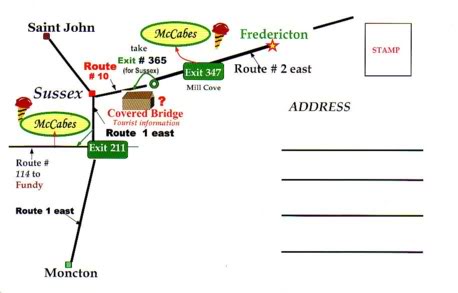
The McCabe's location that we visited is at exit 347 off the Trans-Canada highway, heading east. The other location is at exit 211 off Highway 114, heading to Fundy, as illustrated on the back of the postcard.
Friday, July 24, 2009

Fredericton's Architectural Atrocities: A Tour

Founded in 1783, New Brunswick's capital city is replete with beautiful old architecture of a range of periods and styles, from Georgian to Victorian and beyond. When people and places are fortunate enough to have an abundance of something, there is a tendency to take it for granted. The scars of this attitude are visible all over Fredericton, where few people think anything of busting a hole in the side of a grand old home, church or other building so that they can put up some tasteless but convenient addition.

That is why I am proud to offer the only tour of Fredericton's Really Bad Architectural Decisions available either online or off. At the end of the post, you will find a map of this walking tour, suitable for printing, so that if you are ever in Fredericton, you can get the full experience. In the meantime, I hope you enjoy this virtual tour.

King's Place is a good spot to begin, as it is right in the centre of downtown, and all the buses stop there. Let's gather at the side door, where the pharmacy is located, and begin to walk south down York Street.

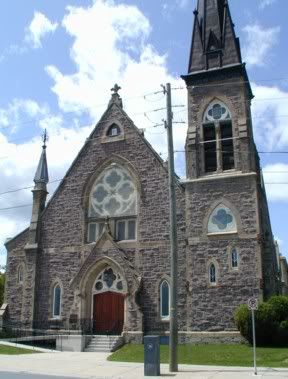
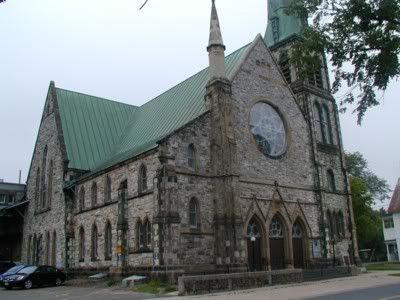
Crossing Brunswick Street and York Street, the first notable piece of architecture we come to is the Brunswick Street United Baptist Church. I believe this would be considered an example of Gothic revival. You can see that it has a tower so tall that I couldn't fit it in the picture. It's not my favorite--that would be St. Paul's United Church, just a short way down the street--but it's still quite an attractive church.

However, keep walking, and you will soon see that something odd is attached to it.

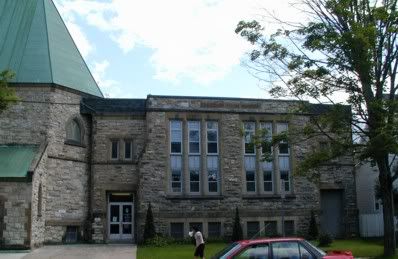
It's not a terrible piece of architecture in itself. It bears some slight resemblance to York House next door (not shown here because it's not part of the tour, but if you want to see a picture of it, click on the link). The one thing it does not resemble, in any way whatsoever, is the church to which it is attached. Not that I think that would make it OK. Putting an addition on a lovely old church is tasteless and wrong, period. But if you're going to do it, the least you can do is make some effort to make it match. That was not done here. Indeed, it appears to be part of this church's tradition to show utter disregard for historical structures. That building next door I just mentioned, York House? They wanted to tear it down, and the city had to buy it to prevent that happening.

Let us move on from this unfortunate church. At the next corner, look across George Street and you will see my favorite church in Fredericton: St. Paul's United Church. It is quite similar to the Baptist Church, and I don't know why I like it so much better. I just do.

According to the plaque out front, St. Paul's was built in 1886 (in the same time period as the Baptist Church, which was built in 1883) and is "a fine example of High Victorian Gothic Revival architecture." Indeed it is. Unfortunately, that's not the only thing it's an example of, as you'll see if you continue down York Street:

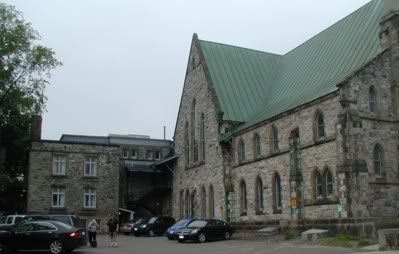
Here we can at least say that some effort was made to make the addition match its host. Although the new structure's windows are rectangular in contrast to the original church's arched windows, and it has the flat-roofed stumpiness of all additions, the stonework is similar. Still, there is no getting around the fact that the effect is not at all what the architects of the original church had in mind. Earlier on, I mentioned the tall towers that are a feature of this kind of church. These, the pointed arches, and other features of a Gothic-style church are meant to draw the eye upward, towards God. Stick a stumpy thing on the church's side and the effect is much diminished. Further, Gothic churches like this are constructed in the form of a cross. The addition interferes with that effect.

Still, it could be worse. And later in the tour, it will be.

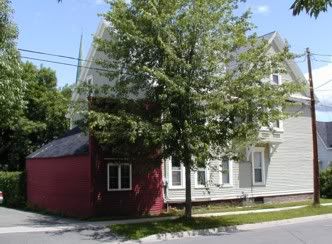
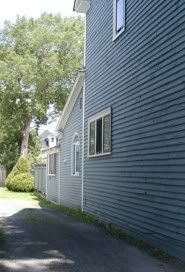
Continuing down York Street, we come to Charlotte Street. Turn right and walk down Charlotte for a block. You will see many nice old houses, and if you take care to look between the houses, you will see many additions. Here's an entertaining example from the corner of York and Charlotte. Usually, additions are at least the same colour as the host house. Not so here, and that's not the only odd thing. There is a tree in the way, but if you look closely, you will see that although the addition has a sloping roof, the wall at the edge of the sidewalk is rectangular. It's a false front, like something out of a frontier town. Just plain weird.
Now we come to Westmorland Street, and our final church. (I didn't mean to squash all the churches to the front of the tour; it just worked out that way.)

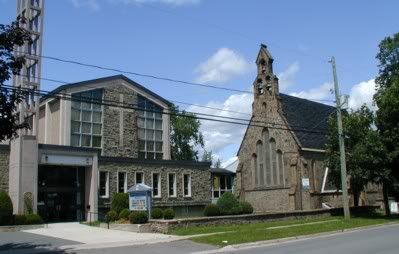
On the right in the photo below is St. Anne's Chapel of Ease, which dates back to 1847. Like the other two churches, it is an example of Gothic Revival, though because it is a chapel, it lacks the towers and cruciform structure we saw earlier. You can't see the stained glass windows from the outside, as they are covered, but they are visible on the inside and are beautiful, as is the rest of the interiour. Do go inside if you get the chance. There are free tours on offer during the summer.

On the left is the Christ Church Parish Church, built in 1962. It is not beautiful. It does have a tower, which looks something like an electrical pylon. Well, there's no help for that, is there? The congregation grew too big for the old chapel, so a new church had to be built. And it would never be beautiful like the old one because, let's face it, we are living through an architectural dark age. So what could they have done differently?

Here's what: they could have made the new church a completely separate structure. In fact, the new church is attached to the old chapel. If you look closely at the photo, you will see the walkway that connects them, making the new church a kind of immensely bloated addition.

There's no way to do something like that without damaging the old structure. From the inside of the chapel, you can see that one of the stained glass windows has been shortened from the bottom to make room for the door to the addition. The bottom of the window is gone, and the chapel has been diminished--in a small way, perhaps, but diminished nonetheless. And all to permit people to walk between the two buildings without going outdoors. One would think this was done because of our cold winters, but the old chapel isn't even heated! What was the point, then? Why did they do it?

I suspect because it never crossed their minds to do otherwise. Additions are a way of life in Fredericton, and therefore are seldom recognized as the acts of vandalism they so often are.

Continue up Westmorland Street, and turn right at the next corner. We are back on George Street, which like Charlotte Street has many fine old houses with strange additions. I particularly like Number 329. It's a great example of the Serial Additions Phenomenon.
An addition is generally smaller than whatever it is attached to, so when there is more than one addition, you can get a sort of regressive effect, as here. The last and shortest thing you can see at the end is probably a deck, or a fence around the backyard.

Crossing at York Street, we're back at St. Paul's United Church. This time, we're passing it on the other side, and you can see that the addition is large enough to stick out quite a bit at this end as well.

We now have a couple of long blocks to walk before we get to the next notable addition, so have a look around at all the old houses on George Street, and their peculiar additions.

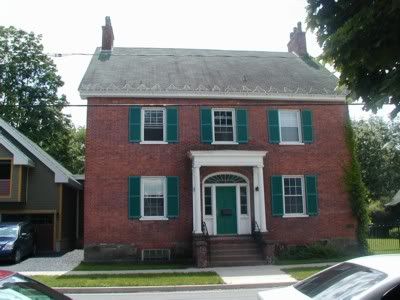
Once across St. John, we come at last to 734 George Street. At first glance, it's a stately Georgian-style home. But wait, what is that puke-coloured stripy thing on the side?

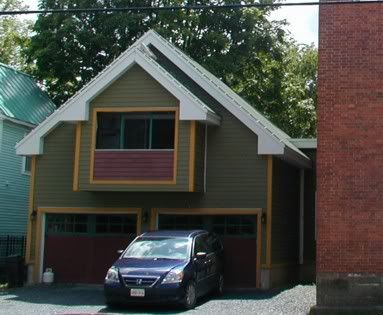
No. Can it be? It is! Somebody took a nice old brick house and attached a garage on one side, and some sort of other thing on the other, and painted them... green and red with amber trim! And to top it off, there are those triangular... I guess decorative elements, for lack of a better word, coming off the eaves.

These structures don't even look good on their own, much less stuck on the house. The tastelessness is breathtaking. It's so bad, it's almost good, in a sick sort of way.
This house went on sale a few years ago. The owner was so proud of what he'd done to it that his asking price was half a million. I recall that it was on the market for some time. The best part of this was the picture on MLS of the back view of the house, with its horrible yet hilarious addition. I emailed the link to my family and we all laughed our heads off.

On the front of the house is a plaque. Here is what it says:

The Rectory 1829
This Georgian residence, built by St. Anne's Parish Church for the rector, was the home of the famous literary Roberts family.

This is when the laughter dies. This house is a heritage site, and the city still let the previous owner do this to it. It's disgraceful, but apparently rich people can do whatever the hell they want.

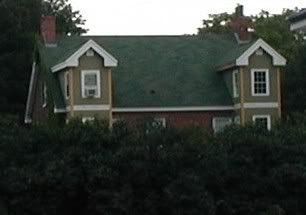
Let's have a moment of silence and retrace our steps a little bit. Back to St. John, turn left, walk to the end of the block and turn left again. Now we're at the other end of the block, and can get a little glimpse of the back end of the house, in between Numbers 719 and 729. (Yes, they're consecutive. Don't ask me why they're numbered that way; ask the city.)

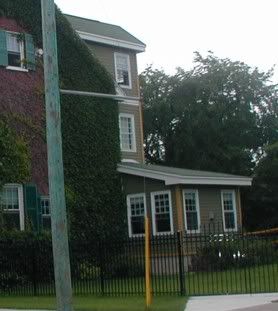
I wish I'd had the foresight to save that MLS picture, but I didn't. This is the best I can currently do to show you the magnitude of the addition. You can see the top, but the bottom is obscured by a hedge. Perhaps in the winter I will be able to obtain a better picture. Still, look at those two tower/dormer-window things jutting up, remember the two other pieces you saw before, and keep in mind that they are all connected. No kidding, that's one big monster, stuck on the back and wrapping around like a parasite feeding off 734 George Street.
Let's move on. I can't say "the worst is yet to come," because that was pretty bad, but the next one is pretty bad too. It's hard to say which is worse.

Continuing down Charlotte Street, we come at the next corner to Church Street. You'll spot the next site as soon as we round the corner; it's hard to miss. Right across the street is one of Fredericton's most beautiful houses.

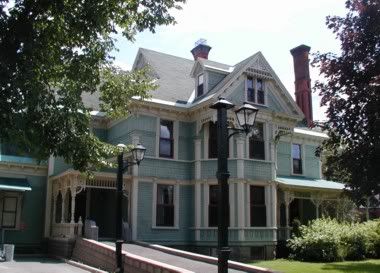
811 Charlotte Street was built in 1895, in a style called Queen Anne. Look at the trim on the eaves and the veranda. It makes me happy just to look at it. I've been inside, and the interior is even more spectacular.

However, when we turn left and walk up Church Street, we see this.

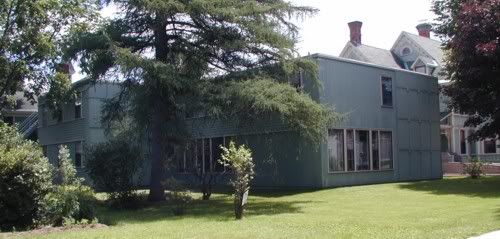
This irregular, boxy affair with its ridges, inexplicable window configuration and overall unwholesome appearance would be ugly all on its own. It becomes all the more hideous when you realize it's attached to 811 Charlotte Street.

811 Charlotte Street currently houses the University of New Brunswick's Renaissance College. Prior to that, it was a student residence with 21 beds. Since it would be difficult to fit 21 beds into one house, the addition must have been built at that time. It is remarkable that something that ugly could have been built in 1949, the year that the house became a residence, but the conclusion is inescapable. The architect responsible should be thoroughly ashamed.

Fortunately, we have a bit of a stroll to get to the next site in the tour. That will give me the opportunity to calm down. Proceed North on Charlotte Street for another two blocks, past Christ Church Cathedral on Brunswick Street, make a left at King and a right at St. John. This will bring us in view of the Fredericton Playhouse at the corner of Queen's Street.

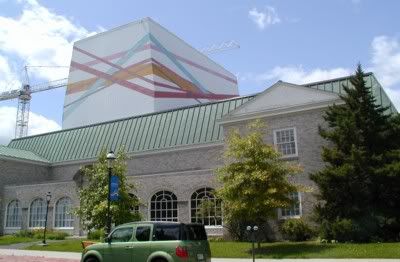
Although it is, for the most part, a reasonably attractive building, the Playhouse is not a heritage site, having been built as recently as 1964. So we don't have to feel too bad about the fact that it has a great bloody rainbow-striped box sticking out of its roof, and we can enjoy a hearty laugh at its expense. The box was added in 1972. It is a fly tower, a space used to house draperies, lights, set pieces and other equipment that can be lowered into place when in use, and raised back up into the tower afterwards. It sounds quite useful, but again, could they not have tried to come up with something that would match, at least a little, the original building? Instead of making the Playhouse look like a nest for a giant bird that laid a square Easter egg?

I once saw the Playhouse addition figured in a pamphlet on Fredericton's outdoor art. That's right, folks, somebody thought the rainbow box was art! Or pretended to.

Speaking of boxes, we have one more stop, so let's turn left on Queen Street and walk three blocks, to where Queen intersects with Carleton. Across Queen Street you will see another heritage building.

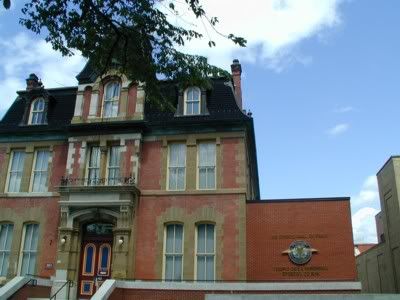
This lovely old structure dates from 1881. The original part is Second Empire style. The addition is Modern Brick Box style. Back in the 19th century, this was the Post Office and Customs House. In 1970, it became the New Brunswick Sports Hall of Fame. That date sounds about right for the brick box. Let's take a closer look at it.

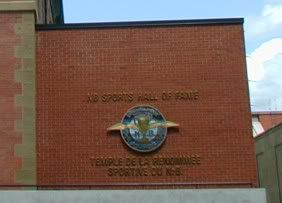
As you can see, it has an attractive crest right in the middle, as well as some lettering that reads "NB Sports Hall of Fame" in both official languages. That was a clever touch. Without the crest, anyone who looked at this addition would immediately think, "Why is there a brick box sticking out of the side of this nice old building?" But with the crest, your eye tends to glide on by. It takes time and many viewings, preferably from different angles, before you become aware that, crest or no crest, you are seeing a graceless brick box sticking out of a heritage structure, and that this involved making a hole in the side of the building and eliminating the windows that used to be there. You become aware that this damage, so cavalierly done, probably can never be undone. The architectural tumour is inoperable.

On that cheery note, this is the end of the tour. If you'd like to return to the spot where we started, you can either continue on Queen Street until York Street, then make a left and walk one more block, or you can turn left here, onto Carleton. Which way is better depends on which post-tour beverage you'd rather ingest. If you'd like something with whipped cream and drizzled chocolate, there's a Starbucks in King's Place at the Carleton-Street end. If you'd prefer an actual coffee, I recommend taking the York Street route. That way, you can get a good coffee at Read's magazine store, right across the street from King's Place.

Enjoy the rest of your day.


And here, as promised, is my walking tour map. Be sure to change your print setting to Landscape before printing.

Thursday, March 12, 2009

My Weekend In Prince Edward Island

I may not be in primary school anymore, but that doesn't mean I can't write about What I Did On My Summer Vacation. It may be an odd time of year for it, but keep in mind I only started this blog in December.

We were only there for a weekend and had time only to see a tiny fraction of PEI, so don't take this as a comprehensive review, but my favorite spot was the national park in Cavendish. Lucy Maud Montgomery, author of Anne of Green Gables, was also fond of it, and is quoted on some of its placards. From a boardwalk leading through a marsh, you can see a tremendous array of life. When I saw that parts of the water were bright green, I was at first concerned it was an algae bloom. On closer inspection, the green carpet turned out to be made up of thousands of tiny plants that floated on the water. I'd never seen anything like it before. I still don't know what it was, since they had no placard for it.

Close by the marsh is a beautiful beach where the famous red sand and sandstone cliffs are on full display. Though it was July, you could only wade into the seawater for half a minute before the ache of cold in your bones would send you running screaming back out again.

Don't expect me to continue in this cheerful vein; not as long as there's something to complain about. I don't call this blog Kvetch of the Day for nothing.

I think PEI must be located in some sort of Canadian version of the Bermuda Triangle. What I mean, if you will excuse a brief slide into vulgar colloquialism, is that there is some weird shit going down over there.

Foremost of which is the tendency of shopkeepers to peel the "Made in China" stickers off their merchandise. When I first saw this, it was in a restaurant in Cornwall that had a few touristy items for sale at the counter: little wooden boats, doodads with shells glued on, that kind of thing. I picked one up and turned it over to discover paper and glue remnants in a partial oval. This surprising discovery led me to turn over all the knick-knacks. One or two still had their "Made in China" stickers; all the rest had been peeled.

I thought it must have been an oddity of that particular restaurant until we went to another restaurant, a huge slop-dishing affair in Cavendish with a gift shop attached. I don't know what possessed me; maybe it's just what I do in stores because I like to know where things come from; in any case, I turned their souvenirs over and found the same thing.

Excuse me, but isn't this illegal? Those stickers are there for a reason. People are entitled to know where their purchases came from. What possesses shopkeepers to do this?

I decided that the shopkeepers must be embarrassed that their souvenirs of P.E.I., seashells and all, were manufactured at the other end of the planet. I wouldn't blame them--for the embarrassment that is--but a better reaction would be stock locally-made souvenirs. Then they wouldn't need to engage in shameful, furtive sticker-picking.

This theory took a bit of a beating when I purchased a metal water bottle at Moonsnail Soapworks & Nature Store in Charlottetown. A very untouristy item, yet when I turned it over... I think you can guess what I found. In fact, you can see it in the picture. PEI has several symbols, including a provincial bird (blue jay) and a provincial flower (lady's slipper), but if they want something that will capture the essence of the tourist experience in PEI, they should consider adding the vaguely oval glue-and-paper smear to the list. I hereby offer this photo to the PEI government for consideration.

The effect of Canada's Bermuda Triangle on the human brain is indeed mysterious, as was brought home to me yet again when I forgot my bathrobe in the room we'd rented at Obanbrae Farm Bed & Breakfast. I called the hostess a couple of days later, only to be told she'd already thrown it out. She didn't even give it to a charity shop. At least then I would have the satisfaction of knowing that somebody somewhere was getting use of a bathrobe that was still in perfectly good condition. But no, I suppose that would have taken up to much of her valuable time, and nothing that did not belong in her neurotically neat domain could be permitted to stay there for more than a couple of days. So into the garbage it went.

Another big surprise was the driving in the Charlottetown area. The sheer number of times you get cut off in a single journey is astounding. It was like driving in Montreal--also an island. Is there something about islands that makes people drive badly? You would think they'd be afraid that their fellow islanders would get fed up and pitch them into the surrounding sea or St. Laurence River. Come to think of it, that's not such a bad idea.

The bad behaviour does not necessarily come to a halt when the vehicle does. James and I stopped at a roadside stand to get junk food. An elderly couple arrived in a truck. The old man parked and left his wife in the idling truck while he bought two ice creams. I expected that he would drive away and eat the ice creams on the road. Instead, he and his wife sat in the truck licking their ice creams, while the truck continued to idle, rumbling pollution into the parking lot so that everyone else lined up at the stand could enjoy the fumes.

After ten minutes, my brain was sufficiently addled by exhaust that it seemed like a good idea to ask him why he was doing this. The influence of the Canadian Bermuda Triangle might also have been a factor. I walked up to the truck and tapped on the driver's side window. He rolled it down.

"Hi," I said. "I'm just wondering why you're idling your motor."

"I don't know," he said. "Why?"

So I enumerated the drawbacks as I perceived them: pollution, noise, waste of gas and money. I finished by saying I couldn't understand why he was doing it.

"No," he said, "I don't expect that someone like you would."

I was still chuckling over this clever witticism when he informed me indignantly that he had to idle the motor or it wouldn't start again.

"Oh," I said.

"And it's none of your business anyway!" said his wife, glaring at me as her husband rolled up the window.

"I just asked a question," I protested through the ever-narrowing gap in the window, but the woman continued to glare at me. So I gave her the finger.

Later, having had some time to think it over, I decided the old goat was probably lying through his teeth. There was a garage a short distance from the food stand. Any sensible person with a non-starting truck would take it to the garage before going for ice cream. If he'd had such a hankering for soft-serve, he could have walked over and bought some while they worked on his truck. Besides, his first response was that he didn't know why he was idling. I suppose he had time to cook something up while I talked.

Why even bother to come up with a story? Why not just say, "I feel like idling my truck. I don't give a damn about pollution. Go away,"? It could be he lied because I'd caught him out and he was feeling embarrassment, much like the merchant peeling "Made in China" stickers.

We spent most of our time in Charlottetown, which in retrospect was a shame. It hasn't got a lot going for it, other than Province House, which is OK. The downtown core consists of restaurants, mostly mediocre, and boutiques which seem chi-chi until you go inside and discover that they're full of merchandise from China with the stickers peeled off. The Chocolate Factory has a lot of mediocre chocolate that is mostly sugar. It is attached to The Anne of Green Gables Store, the ultimate destination for Anne fanatics. (Maybe they should be called Anneatics?) At a nearby theatre, you can see Anne of Green Gables: The Musical, which costs as much as an opera and doesn't have any good songs. You can save a lot of money by hanging out in the Anne of Green Gables Store, where they play the soundtrack. Stay there long enough and you'll hear the whole thing.

It may be PEI's capital city and it may be comparatively near the Confederation Bridge, but Charlottetown is not where you should spend a lot of time in PEI, especially if you're there for a short time as we were.

Speaking of the Confederation Bridge, I'm sure it is a marvel of modern engineering and blah blah blah, but I wish they hadn't built it. They used to have a ferry that went that way. For the same price ($40) we could have been on the water, enjoying the salty spray that they sing about in Anne of Green Gables: The Musical. Instead, we spent ten minutes--and felt every individual minute--staring at a strip of grey cement running off into the empty sky. There is no more boring drive in the world. So what if it's quicker? People need to get over the idea that quicker is better. And they need to make a similar mental shift with regards to "bigger," as exemplified by the hideously inflated tourist "village" that awaits you at the other end of the bridge. That's another wonder of modern engineering that should never have been built.

But to return to my point--don't waste your trip by spending any length of it in the Charlottetown area. Spend your time at the beaches and parks. Our trip improved noticeably when we headed north to Cavendish, and I wish we had sooner. We did not have time to see all the sights in the area, such as Montgomery's house. Next time I think we will immediately head north after crossing the Confederation Bridge, and stay there.