Wednesday, May 11, 2011

Dumb Things People Say: the Mangling of Popular Expressions

Language is for communication. Isn't that obvious? It shouldn't even need to be said. But in fact, it is popular these days to use language for something other than communication. Marketingspeak is meant to lull the reader's brain to sleep with babble that means little, yet is somehow comforting. Meetingspeak and Scholarspeak are meant to make the speaker sound intelligent through the use of polysyllabic, imprecise words that do not make their meaning anywhere near as clear as shorter, simpler words would have done. It appears that as a society, we have largely abandoned the idea that our sentences should make sense. So when common expressions get mangled over time and become nonsense, who's to remark upon it? Other than me, that is.

The language is always changing, of course, and these changes do not always result in nonsense. The word "foundering" has largely been abandoned for the similar-sounding "floundering." Foundering made more sense, but floundering is not altogether nonsensical. One pictures a flounder, out of water, desperately flopping around. On the other hand, when people talk about "flaunting the rules," that's ridiculous, as if rules were a party dress a girl wanted to show off. (The correct word is "flout.")

I, for one, think that language should be used for communication, and hope to turn people back to the path of correct speech through the use of judicious mockery, and, where desirable, cartoons. Here we go.

I could care less

People used to say, "I couldn't care less." It meant they cared very little indeed, or not at all. Now they often say, "I could care less." This should mean that they care somewhat, since it would be possible for them to care less. It could even mean that they do care a fair bit. Yet it is meant to imply a lack of caring, just like the original expression, despite the fact that that's not what the words are saying. This is why people who use this expression tend to sound like idiots.

Party hardy
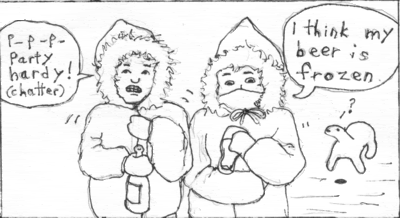
I am pretty sure that this expression started out as "party hearty," with a t. But in North America, t's tend to be pronounced as d's, so that "party hearty" and "party hardy" sound the same. And in a society where sense is not expected, it doesn't matter that "party hearty" means "to party with gusto" and "party hardy" means, one can only suppose, "to party in difficult, inclement conditions." So when the expression got written down, "party hardy," whimsically nonsensical and having one letter fewer, won the day.

One could argue that, strictly speaking, the expression should not even be "party hearty" but "party heartily." But that wouldn't rhyme. Mangling grammar a little in order to achieve a rhyme may be an acceptable exercise of poetic license, especially where common expressions are concerned.

Saying "literally" when you really mean "figuratively"
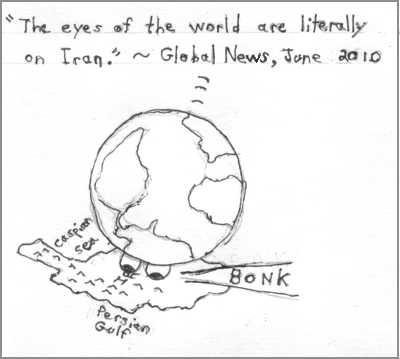
Global News did this. "The eyes of the world are literally on Iran," the broadcaster said. No, the eyes of the world are figuratively on Iran.

If worst comes to worst

If worst comes to worst, then nothing's changed, right? You started out with worst, and you ended with worst. Nothing's happened, so while things might be at their absolute worst, at least they haven't gotten any worse. Not that they could, when they started out at their very worst to begin with. You can't get worse than worst.

If worse comes to worst. That's the expression, OK people? Really, a better expression would be, "if bad comes to worse." Maybe that's what the expression used to be, and people didn't think that was strong enough. But at least, "if worse comes to worst" makes some kind of sense. Things got worse, and then they got as bad as they possibly could—the worst. "Worst comes to worst," on the other hand, makes no sense at all.

If you think [fill in blank], you've got another thing coming
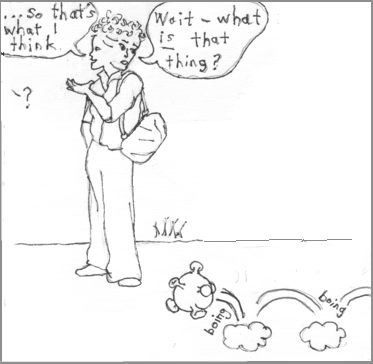
Another thing! You've got a thing coming. I love that. It's so idiotic, it's good. And no less an intellectual than Susie Bright used this expression (in her article about Camille Paglia: "If you think Pat Buchanan calls up Hurricane Camille for strategy sessions, you've got another thing coming"*). Et tu, Susie! What is this thing, exactly, why is it coming, and where is it coming from? Is it not a mystery?

Think. You've got another think coming. Doesn't that make more sense? Of course it does. So do, please. Think before you speak. Ask yourself if what you are about to say makes sense. Think. We'll all be better off for it.


* "Camille Anonymous," San Francisco Review of Books (January/February 1993).

Tuesday, May 10, 2011

Review of Rut by Scott Phillips

RutRut by Scott Phillips
My rating: 3 of 5 stars

This story is set in a near-future dystopian United States. Climate change, pollution and peak oil have all taken their toll on a small town in Colorado. Once a popular tourist destination but now dying, its only visitor is a young biologist, come to study the local frogs. Although frog populations are declining worldwide, frogs are flourishing near this town. However, effluent from a mining operation is having an odd effect on some frogs, leaving them stuck in the tadpole stage; they'll grow up to a foot long, but remain legless, a fate that parallels that of many of the town men, who are missing legs from all the wars they've served in, and a boy named Cole, who's seventeen years old but looks eleven. Like the frogs, his development has been stunted by his environment.

Although this is definitely science fiction, it's not a fast-paced novel with emphasis on action and thrills. Rather, it focuses on the everyday lives of the townspeople and how they react to the arrival of the newcomer. One might classify this as literary fiction, but that doesn't mean it doesn't go anywhere; this ain't The Shipping News. To the contrary, the ending is explosive... and I don't just mean that figuratively. While it's not a page-turner, if you stick with it until the end, it will stick with you.

In fact, I was a little sad to have to give away my copy. This is a Concord Free Press book, which means you get a copy for free but you have to give a donation to a charity of your choice, then pass the book on so that someone else can do the same. So if you want to read it, you can either ask Concord for a free copy (they have a form for that purpose on their web site), wait until somebody gives you their copy, or wait until the novel becomes available from a traditional publisher and buy it. Take your pick.

View all my Goodreads reviews

Thursday, March 3, 2011

The Hobbit by Théâtre Sans Fil: Not That Great, Really

Sometimes, when you take in something that's famous or has been heavily praised, and it doesn't live up to your expectations, it's hard to admit that to yourself. You want to like it, because you think you should. After all, everybody else seems to. I experienced this recently in the context of the puppet show The Hobbit by Montreal-based troupe Théâtre Sans Fil. (I daresay that if you're going to be mediocre, it's a good idea to aim your work at children, who tend to accept things the way they are and don't have extensive critical faculties.)

It was therefore lucky for me that I happened to sit down next to a certain acquaintance. Fredericton is like that. You can decide on the spur of the moment to go to the theatre by yourself, find your way to your reserved seat, and discover that you're right next to someone you know. The city is just that small.

This particular someone is the most upbeat, positive, easily-delighted human being on the planet. She loves everything. For example, I saw she had a Kobo ereader with her in the theatrre. "Oh, I have one too!" I exclaimed. "Do you love it?" was her response. And I felt duty-bound to say, "Uh, yeah," even though, really, I just like it.

But when the show was over, she said, "Well, that was fun." Ouch! Coming from her, that's some pretty damning criticism. So I feel justified in my conclusion that despite its having toured all over Europe, Asia, etc., Théâtre Sans Fil's puppet show is not that great. My friend didn't love it.

The strong point of the production has got to be the puppets, some of which are spectacular. Gandalf and the elves flounce and glitter in their flowing finery. Bilbo, on the other hand, is kind of unattractive. I wondered if his face had been copied from that ugly animated version of The Hobbit. I also wondered why he had green hair.

Another aspect of the Bilbo puppet that I found somewhat distressing is that he never got to use his legs. They just dangled. Is that world-class puppetry? Honestly. With most of the characters, this wasn't a concern because they didn't have legs. Gandalf, the elves and the dwarves were all robe people. But there's Bilbo with an obvious pair of legs and he's swishing around like a seahorse.

I should probably mention here that Théâtre Sans Fil, which means Theatre Without a String, lives up to its name: the puppets are not manipulated from above with string; instead, the puppeteers stand behind the puppets, shrouded in black, and manipulate them directly. It's the same principle that works so well in the Famous People Players shows. Indeed, Théâtre Sans Fil also makes use of ultra-violet light, and the puppets can be seen to glow in moments of low light. It all works to great effect in dark scenes, such as the one in Mirkwood Forest. Indeed, that scene is the highlight of the show. When Bilbo loses contact with the dwarves, glowing filaments appear and spin themselves into spider webs as we watch. Glowing spiders make an appearance soon afterwards, and they're pretty neat too, although they tend to cluster together in suspiciously human shapes.

In well-lit scenes, which, bizarrely, constitute most of the show, the illusion is ruined by the clear sight of people in hoods behind the puppets. One is at a loss to explain such unprofessionalism. Why did they choose to beam lights all over the puppeteers during most of the scenes? Didn't they check how it would look beforehand?

Mind you, this gaffe did add an interesting element to the dwarf puppetry. Most of the dwarves in The Hobbit are fairly anonymous and interchangeable, as suggested by their rhyming names: Fili and Kili, Bifur, Bofur and Bombur,and so forth. In tacit acknowledgement of this fact, the puppeteers often lined up a row of dwarf puppets on a pole or rod of some kind and waved it back and forth, making it look as if the dwarves were playing see-saw in the park. Well, when you could see the puppeteer's heads sticking out from behind the waving dwarf-row, which was most of the time, it looked as if there were extra, black-hooded dwarves behind the first row. Like mirrors in a dining hall, it made the dwarf entourage appear bigger than it was. Definitely what you want when you're going up against a fire-breathing dragon.

But back to Bilbo's limp legs. When doing this kind of puppeteering, it is a simple matter to control the legs, more so than with marionette puppeteering I should think. All one needs are sticks connecting each leg of the puppeteer to the corresponding leg of the puppet. Indeed, this was done with the trolls, who had legs, and Gollum, who also had huge feet and was one of the most appealing personages in the show. Yet Bilbo, the main character over whom one would expect more care to be taken, was left dangling, literally.

With the exception of Bilbo and his legs, most of the production design effort went into the puppets. The set was exceedingly sparse, consisting mostly of Bilbo's front door and a couple of big wooden things that looked like boxes with jointed lids. These two boxes were moved around to be made into everything: Bilbo's table, hills, cave openings and so on. Sometimes this worked out better than at other times. In particular, things became odd and confusing as Bilbo wandered around looking for food before running into the trolls. He approached a box, hovered over its open lid, ineffectual legs flapping, and when he got to the other side, the lid apparently tried to close on him, but he managed to wiggle out of the way. I wracked my brain trying to figure out what this alien landscape was supposed to represent. I don't recall troll country being described that way in the book.

In addition to Bilbo's leg handicap, fortunately compensated for by his hovering abilities, Bilbo is haunted by two oppressive forces that follow him around: irritating music and excessive narration. The music is the sort of relentlessly peppy stuff that gets foisted on kids. Maybe they like it; I don't know, but like it or hate it, it sometimes makes the narration difficult to hear.

As for the narration, I realize that if you want to condense a novel with a complex plot into a puppet show that lasts an hour and a half, you're probably going to have to narrate something. But you ought to refrain from narrating things that could be better expressed in dialogue. The tendency to overnarrate got underway fairly early on and worsened as the show continued. Near the end, practically everything was narrated. Thorin Oakenshield's rage at having the Arkenstone withheld from him as well as his eventual conciliation is all dispatched in one sentence. They seemed in a raging hurry to get the play over with so that everybody could go home.

Earlier I mentioned the dragon, Smaug. The Smaug puppet is a fine one, decked out in glowing ultraviolet reds and greens. Ironically, its failing is its lack of flaw. Smaug is supposed to have a vulnerable, bare spot on his left breast. This is mentioned no less than three times in the play, once by the narrator, once by Bilbo, and once by a helpful bird. Furthermore, Bard of Laketown stabs at it with a sword. (In the book, he uses an arrow, but I suppose that's difficult to pull off with puppets.)

But where is this bare spot? Nowhere to be seen, and I think this may be the stupidest oversight of the whole sadly mediocre puppet show. It would have been so simple a matter to, say, glue or sew a piece of black felt onto the left underside of the puppet. It would have shown up so well against the ultraviolet colours. But they didn't. Why didn't they? Why did they allow this confusing inconsistency to stand? My guess is that they didn't give a crap. After all, if they were interested in or capable of attention to detail, I wouldn't have found so many details to pick on and the whole production would have been much more enjoyable.

In conclusion, while some spectacular performers and troupes have emerged from Montreal, Théâtre Sans Fil is not one of them. At the end of the play, the senior member of the troupe announced that they are working on a puppet version of Weaveworld by Clive Barker. I expect it will be similarly mediocre. But the puppets will look great.

Saturday, December 25, 2010

My Christmas Dinner 2010: Recipes and Suggestions

You may be wondering what a Jewish woman is doing preparing Christmas dinner, much less writing about it. It's true that I'm nominally Jewish, but the ubiquitousness of Christmas--the carols, the TV specials, the shopping madness, the time off work--is a reality of the culture in which I live. Anyway, Paganism has always spoken to me more than Judaism or any other religion that emerged from the Middle East, and really, Christmas is Yule, a pagan celebration of the winter solstice. None of the customs, from tree decorating to lights, have a thing to do with Jesus, who, if he ever existed (which some have called into question), was born in a desert in July, and was, to boot, a nice Jewish boy. So there. Now on to the food.

Sweet Potato and Apple Stuffing

This is a modified version of a recipe I got from The Good Cook: Poultry, by Time-Life books, who in turn got it from Louisiana. I'm always interested in stuffings that don't contain bread. In addition to being a pleasant change from the ordinary bread-based stuffing, they are gluten free and good for celiacs and anyone else who doesn't do well with wheat. It's delicious too.

The original recipe calls for sugar. A lot of recipes with sweet things in them call for sugar. Sweet potatoes with sugar. Beets with sugar. And so on. I have always found this to be insane. It's like putting blue eyeshadow on a blue-eyed woman "to bring out her eyes," except that instead of simply being in bad taste, it's bad for your health as well. No sugar in this version, and it's still plenty sweet.

  • 4 cups diced apples
  • 1 cup chopped celery (I didn't have any, so I used white turnip)
  • 1 cup water
  • 6 sweet potatoes (about 3 lb.)
  • 2 tbsp lemon juice (I used cider vinegar)
  • 1 tsp ground cinnamon
  • 4 tbsp butter
  • 1 cup chopped pecans or walnuts
  • grated peel of 1 lemon (I left this out)

The recipe said to peel the apples and sweet potatoes, but I didn't bother. Both have perfectly edible skins. Yes, the sweet potato does too. Try it some time; it saves effort and reduces food waste.

Steam or boil the sweet potatoes for 25 minutes. While you mash the sweet potatoes with the butter and cinnamon, simmer the apples and celery in the water until tender. (If you use turnip, as I did, you'll need to put it in first because it takes longer to cook than the apple.) Mix the apples, celery and chopped nuts into the sweet potato mush and stuff it into your turkey.

Turkey-Cooking Suggestion

Cookbooks and every other turkey-cooking expert I've ever heard of advise you to place the turkey on its back to cook it. It is, I believe, a presentation thing, but results in the quickest-cooking part of the bird--the breast--being exposed to the most heat. You are then expected to get around this by basting, or by covering the breast with bacon. If you're lucky, it works out. More likely, you end up eating overcooked breast meat, or slicing off the breast meat and eating it first while you put the still-uncooked remains back in the oven, because you've been waiting for hours and you're starving and you can't take it any longer.

Well, try this. Place the turkey on its breast instead. Now the dark meat, which takes longer to cook, is getting the most heat, while the white meat is protected from being overcooked. Doesn't that make more sense? I think so. It's what I did this year and my turkey came out perfect. The stuffing was fabulous too--better than cranberry sauce.

Mince Pie

A modified version of a recipe from The Vegetarian Feast by Martha Rose Shulman. Here's another recipe that cries out to have its sugar removed. It's made mostly from dried fruit, which is very sweet, plus it contains juice. Why would you add sugar, or even honey or other sweetener? That would be dumb. Leave it out, and you can actually taste the fruit. And buying mince pie filling in a jar, when you can easily make a more delicious version at home, is also questionable.

  • 1 pie crust (see below)
  • 1/2 cup currants
  • 1/2 cup raisins
  • 2 apples (I used russets; they're very nice)
  • 1/3 cup chopped, pitted prunes
  • 1/3 cup chopped, dried, pitted apricots (get the sulfite-free ones from the health food store; they're better for you)
  • 1/4 cup chopped, pitted dates
  • 1/2 cup broken pecans or walnuts
  • Juice and grated peel of 1 orange (I used a Mandarin orange)
  • 1/4 cup water
  • 1/2 tsp ground cinnamon
  • 1/2 tsp ground clove
  • 1/4 tsp ground nutmeg
  • 3 tbsp rum (I used Screech rum from Newfoundland; good stuff)

Since preparing Christmas dinner is a huge chore, a job for a masochist, it's a good idea to make the filling part the day before. Grate the orange peel, then cut the orange in half and juice it. (At which point, if you used a Mandarin orange as did I, you will discover that the peel disintegrates under the stress. So proceed with care.) Throw the dried fruits, nuts, juice, peel and water into a pot, bring to a simmer, cover, and cook over low heat for 20 minutes or until it's all nice and mushy. Add the spices and booze, mix and cook for another 5 minutes. There. You're done. Told you it was easy.

Pie crust

One of the things that has mystified me all my cooking life is why cookbooks call for such a small amount of water in pie crust. "Oh yes," they coo, the liars, "just chill those 3 dainty tablespoons of water with those ice cubes, and your crust will be fine." Then you try to roll it and it cracks into particles like a freshly-unwrapped ancient mummy. (Sorry if that metaphor wasn't appetizing.) Well, I've had it. I'm doubling the water quantity, and if any pie crust experts out there want to float over to this blog and mock me, feel free. I'll just ignore you.

  • 2 cups some kind of flour (this year, I used 1 cup brown rice flour and 1 cup buckwheat)
  • 1/2 tsp salt
  • 1/2 oil or fat (I used chicken fat. There, that's Jewish)
  • 1/2 cup or more water, and I don't believe it makes any difference whether it's iced or not

Preheat oven to 350 degrees F. Combine dry ingredients. Work fat into flour mixture with hands, a butter knife or one of those pastry cutter things until the little bits are smaller than peas. Mix in the water and add as much as you need to make a dough that holds together. Roll the dough out on a floured surface, or if that doesn't work out for you, which it often doesn't for me, pick it up in little pieces and press it into the pie pan, as you would for a crumble crust. There's no shame in that. Pie crust is like love and war: all's fair so long as it gets the job done. Poke a bunch of holes in the bottom with a fork and prebake for 5 minutes.

Remove from oven and cool, then spoon in the mince. Top with a lattice crust if you like, or with an unbroken top crust, or even sprinkle the dough on like a Dutch apple pie topping if that works better for you. Did I mention pie crust is like love and war? Now stick it back in the oven and bake for 40 minutes. Cool and eat, if you have any room after all that turkey. If not, it makes a delightful breakfast.

--Brought to you by The Rebel Cook (my new name for my cooking alter ego)

Monday, October 11, 2010

Mildly Amusing Writing Exercises: Nursery Rhyme + Genre

In writer's groups I belong to, or have belonged to, we sometimes do writing exercises. Most of them have been focused not so much on honing specific stylistic skills as on getting the creative juices flowing while having fun at the same time. As a result, we tend to lean toward the funny and silly exercises. After which, one is left with a piece of writing that one doesn't know what to do with. (Look, I just ended a sentence with a preposition. If only my writing exercises were more highbrow, I might have known better.)

I have old writing exercise results lying around that I am fond of, even perversely proud of. It seems a shame that they are only seeing the inside of my underwear drawer. Still, it's not as if I can submit them for publication. But here's a thought: I could post them on my blog.

One of my writing friends is fond of nursery rhymes, and she came up with the following writing exercise. Write several nursery rhymes down on little scraps of paper and put them in a hat. Then write down several genre names and put them in a separate hat. Each participating writer draws one piece of paper from each hat, that is, one nursery rhyme and one genre. The challenge is then to write a short story in the given genre, that somehow references the nursery rhyme.

I did two of these. See if you can guess both nursery rhyme and genre.


"Captain Wutax!" A note of alarm crept into the ensign's voice. "A Knitter's Guild vessel just decloaked off our starboard bow."

Before Captain Wutax could respond, the ensign cried, "They're powering weapons, Sir!"

"Raise shields," barked Captain Wutax, his jaw jutting out manfully.

"Shields at maximum. They're hailing us, Sir."

"Open a communication link. Onscreen."

With an electronic chirp, the hated face of Mrs. Connor, compulsive knitter, appeared onscreen. Fear and loathing twisted in Captain Wutax's guts as he saw she was swathed in a hand-knitted Victorian lace shawl over her hand-knitted cable sweater. The woman had no notion of when to stop. It was said that the Guild kept its ship ice-cold. Otherwise they'd swelter under all that knitted stuff.

"This is Captain Wutax of the Black Sheep. What do you want?"

"I think you know exactly what I want," drawled Mrs. Connor. "We know you've got wool. Hand it over."

"The Black Sheep has no wool for you!" thundered Captain Wutax.

"Don't hand me that. I know you have three bays full."

"Yes, for Master Blaster and his wife. They're going to share it with little Kimmy. We have wool for honest, paying customers, not pirates like you."

Mrs. Connor's mouth twisted. "Fine. If that's the way it's going to go. Let's see if your shields can stand up to our Needle of Doom!" The screen went black.

"Evasive manoeuvres," barked Wutax. "And arm... the Crotchet Hook!"

* * *

Nursery rhyme and genre: Baa Baa Black Sheep/Space Opera. I know it sounds a lot like a Star Trek rip-off. That's because I haven't been exposed to much space opera, so Star Trek naturally came to mind. By the way, I was going for a cheesy, overwritten effect. That's why so many faces are twisting and jaws are jutting manfully. I don't normally write that way. Honest.


As the police officer outlined the body in chalk, Sherlock Columbo took in the sumptuous surroundings. "Lovely place you've got here," he remarked absently to the distraught young woman on the sofa. She'd stopped crying, but her eyes were red-rimmed and the tissue in her hands had disintegrated into moist little shreds. "That's a very nice sofa," Columbo continued. "I bet that's no later than 18th century." She gazed at him with bewilderment.

"That's a nice piece too." He nodded at the grandfather clock that rose above the corpse. "Excellent condition."

Watson, his assistant, leaned in close and said in a low voice, "Sherlock, the young lady is obviously upset. Do you think it's appropriate..."

"Oh! I'm sorry." Columbo smiled at the woman, who dissolved into fresh tears. "Oh now... here, take my handkerchief." He whipped the white cloth out of his breast pocket and handed it to her. She blew her nose with a loud honk.

"Keep it. I have plenty."

He turned to Watson. "One thing we know," he murmured, "is that the murder occurred between midnight and one in the morning."

"We do? How do we know that?"

"You'll notice the mouse." Columbo pointed, and Watson saw the tiny black eyes peeking out from behind the pendulum. "As we know from the scientific reports the deceased published in Nature Journal, this mouse was in the habit of running up the clock at midnight, and back down at one. It was like... well, clockwork." Columbo allowed himself a small chuckle. "And yet the mouse is still in the clock. Why?"

Watson looked at the body. "The mouse was afraid to come down because of the body at the base of the clock. Very clever, Sherlock!"

"Elementary, my dear Watson."

* * *

Nursery rhyme and genre: Hickory Dickory Dock, the mouse ran up the clock/Mystery.


Wasn't that fun? Maybe I'll post some more later.

Sunday, September 12, 2010

FYI: Eighties Music Really Did Suck

How do you know when you're getting old? Is it when that first grey hair appears, or the first time you groan as you hoist yourself out of a chair? Well, here's my definition: you know you're getting old when the music of your youth develops nostalgia value. This has happened to me. It's become a common thing for night clubs to have "eighties nights." That makes me feel ancient.

Is it just a matter of the eighties getting their turn? After all, clubs used to have sixties nights and seventies nights (maybe some still do) and many radio stations devote themselves to these decades. But you see, there's a difference: the eighties were musically wretched. It wasn't all Duran Duran, Thomas Dolby and Bruce Springsteen. It was also Mr. Mister, Soft Cell and Toto.

I decided that there was a need for this essay one summer evening. I was at a friend's house watching a DVD of the eighties stage musical, Chess. If no bells of recognition are going off in your head, this might help: the eighties hit, One Night in Bangkok, is from this play.

Watching this eighties play led to talk of eighties music. The youngest person in the room, a striking beauty in her twenties, mentioned eighties nights in clubs and how fun they are. I felt a moral obligation to speak up.

"You know, eighties music really sucked. People don't realize that because nowadays they only play the good stuff. They never play all those shitty songs that were on the radio when I was a teenager."

"But that's true of any decade," our hostess pointed out. "They only play the good songs from the seventies, too."

She had a point. So what is my basis for claiming, nonetheless, that the eighties sucked worse than other decades, musically speaking?

The Argument

For one thing, I've lived through other decades, so I do have a basis for comparison. I can vouch for the fact that the radioscape improved immeasurably once the eighties ended and the nineties began. It was great; finally we were through the bland desert of tinny electropop and into a verdant landscape of Third Eye Blind, Matchbox 20, etc. The noughts were also good, as far as I could tell, though I've spent the latter half of them in a town largely devoid of decent music radio.

I can't speak with authority of the decades that preceded the eighties, since I either wasn't around yet, or was too young to tune my own radio dial. But I have some idea, at least of the sixties, because my brother had Woodstock on a set of vinyl records. Not just the best of Woodstock—the whole thing. It stands to reason that the decade's most massive, notorious concert would include artists that faded into obscurity as well as the ones who are still remembered, and it does. Many of the songs on the Woodstock album were just OK, or even forgettable, but there is not the killing monotony of sound that marked the eighties.

I don't think so, anyway. This is only my opinion, and you may well be asking yourself why should give it any credence. That brings me to my other point: I am not the only one who found the eighties to be musically monotonous. The Fifth Estate did a segment on it once. I have tried to find out which episode it was, but the CBC has been diligently at work making its web site ever less navigable and functional, and I was unable to glean anything from it. I'll have to settle for estimating that the episode aired in the late eighties to early nineties. It discussed the bland sameness that possessed radio stations in this period and the independent music industry that sprang up in response. I remember the narrator stating that many of these new outsider bands sounded angry, and they had reason to be: radio was neglecting them. Alternative bands existed throughout the eighties, but did not get played on mainstream radio stations until the nineties. Not on any that I had access to, anyway.

The Evidence

I can argue myself blue in the face on this point, but unless I can give you a listen to the sort of crud I heard as a teenager every time I turned on the radio, you are unlikely to be persuaded. And thanks to Jango, I can do just that.

Jango is a free, web-based service that lets users create their own "radio stations." Here's how it works: you type the name of a musical artist into the search box. If it's found, Jango will create a new station named after the artist (you can rename it if you want) and begin playing a random selection from that artist. But it will go one better than that. It will provide a list of similar artists that you might also enjoy and want to add to your station, and it will insert their songs into the playlist. Jango is pretty good at finding matches by style and period.

The idea, of course, is to present you with music you will like, but there's nothing to stop you from using it for other, more nefarious purposes. I found it an invaluable tool for digging up all those old forgotten bands that dissolved my brain cells during my youth. I got the ball rolling with The Thompson Twins, and soon I had a whole stack of dismal bands. Mind you, The Thompson Twins weren't the worst the eighties had to offer. (I'd tried Chalk Circle first, a band I remember with deep disgust, but Jango didn't know it.) However, Jango helpfully brought up other bands that were even lamer, and I added the worst of them until I created a station that is truly soul-destroying. I offer it here for your listening displeasure: Vivian's Bad Eighties Music. Take only in small doses, and bear in mind that this is what about three-quarters of airplay sounded like during my formative years. Condolences accepted.

To be fair and balanced, I also created a Jango station of good eighties music. This one, Vivian's Good Eighties Music, reproduces the experience of going to one of those eighties club nights.

The Playlists

Here are the playlists for my two Jango radio stations. Keep in mind that these lists do not encompass everything you will hear on these stations, since Jango inserts its own "recommendations" from time to time.

Bad Eighties Music

  1. Icehouse
  2. Book of Love
  3. Depeche Mode
  4. Johnny Hates Jazz
  5. Love and Rockets
  6. Mr. Mister
  7. The Housemartins
  8. Soft Cell
  9. Orchestral Manoeuvres in the Dark
  10. XTC
  11. The The
  12. Missing Persons
  13. Berlin
  14. Cutting Crew
  15. Thompson Twins
  16. China Crisis
  17. Toto

Good Eighties Music

  1. Simple Minds
  2. Fine Young Cannibals
  3. The Fixx
  4. Eurythmics
  5. Duran Duran
  6. Pet Shop Boys
  7. The Human League
  8. ABC
  9. The Cars
  10. T'Pau
  11. Spandau Ballet
  12. a-ha
  13. Bronski Beat
  14. Arcadia
  15. Thomas Dolby
  16. Wham!
  17. Yazoo

Monday, August 16, 2010

Omigod What an Awful Sentence

It is said, "Those who can't do, teach." At times I think one could just as well replace the word "do" with "write" and the word "teach" with "edit." Which is fine. After all, we writers need editors so that we can get our work perfected and published. That's the theory, at least. The reality is more like, we writers need editors to send us rejections containing foolish remarks or cryptic "advice." I got a particularly disturbing rejection letter yesterday, which I may make fun of later. But not right now. Right now, I'm making fun of something else, because I need to find another place to send this rejected story, a need that sent me to the Internet, which in turn led me to an article entitled, "A Comprehensive and Totally Universal Listing of Every Problem a Story Has Ever Had."

Just the thing for a writer who's been rejected, right? Well, you would think. But there's the problem mentioned above: editors often can't write. This fellow admits as much, calling himself "a tolerably mediocre author who has seen more form-letter rejections than penis-enlargement spams." Having gotten just short of halfway through his article, I agree with all of that statement except the "tolerable" part. Now, it's great that he has found a way around his unfortunate handicap--by becoming an editor--and kind of him to share his hard-earned knowledge with us writers so we can improve ourselves... I guess. I confess, I'm always a little suspicious of constructive criticism, especially the unsolicited kind. What portion of the motive is sincere helpfulness, and what portion is smug superiority? Even putting that aside, good intentions and frank admission of shortcomings are nice but not enough in themselves. If you know you don't write very well and you still want to get your wisdom out to the world, you need to get yourself--now, this is ironic--an editor. Or perhaps a ghost writer. If you don't, you're liable to end up embarrassing yourself in front of the world with sentences like this:

Point of view failures are usually some kind of loss of containment, such as when the narrative voice is first person but the narrative perception starts slipping off to places where the narrative character could not carry the reader or a third person POV that usually stays outside on the shoulder of characters but sometimes jumps inside the head for a first-person peek.

No joke, I read this sentence five or six times and I'm still not sure what he's trying to say. The latter half of the sentence is particularly scary: a mess of interlocking, ambiguous subordinate clauses. Sentences like this happen when a "writer" gets more involved in showing how clever and imaginative he thinks he is than in conveying his meaning to the reader. That this particular "writer" was absorbed with his cleverness and imagination, or imagined cleverness, is shown earlier in the article. Unnecessary zombie and condom metaphors abounded, but the thing was still readable. It is this one sentence, the sentence from the eleventh layer of hell (also mentioned in the article) that stops a reader dead, like the sight of two shattered cars by the side of the road. And when said reader stops reading altogether in order to make fun of the sentence on her blog, then clearly the article has failed. Which is a shame, because the world can indeed use a comprehensive listing of things that can go wrong in a piece of writing. I can't help but notice, however, that this one isn't completely comprehensive. After all, it makes no mention of long, convoluted, horrible sentences. Hmm. Maybe that's a blind spot.

Mockery aside, the article does make some good points. Read it, if you can.